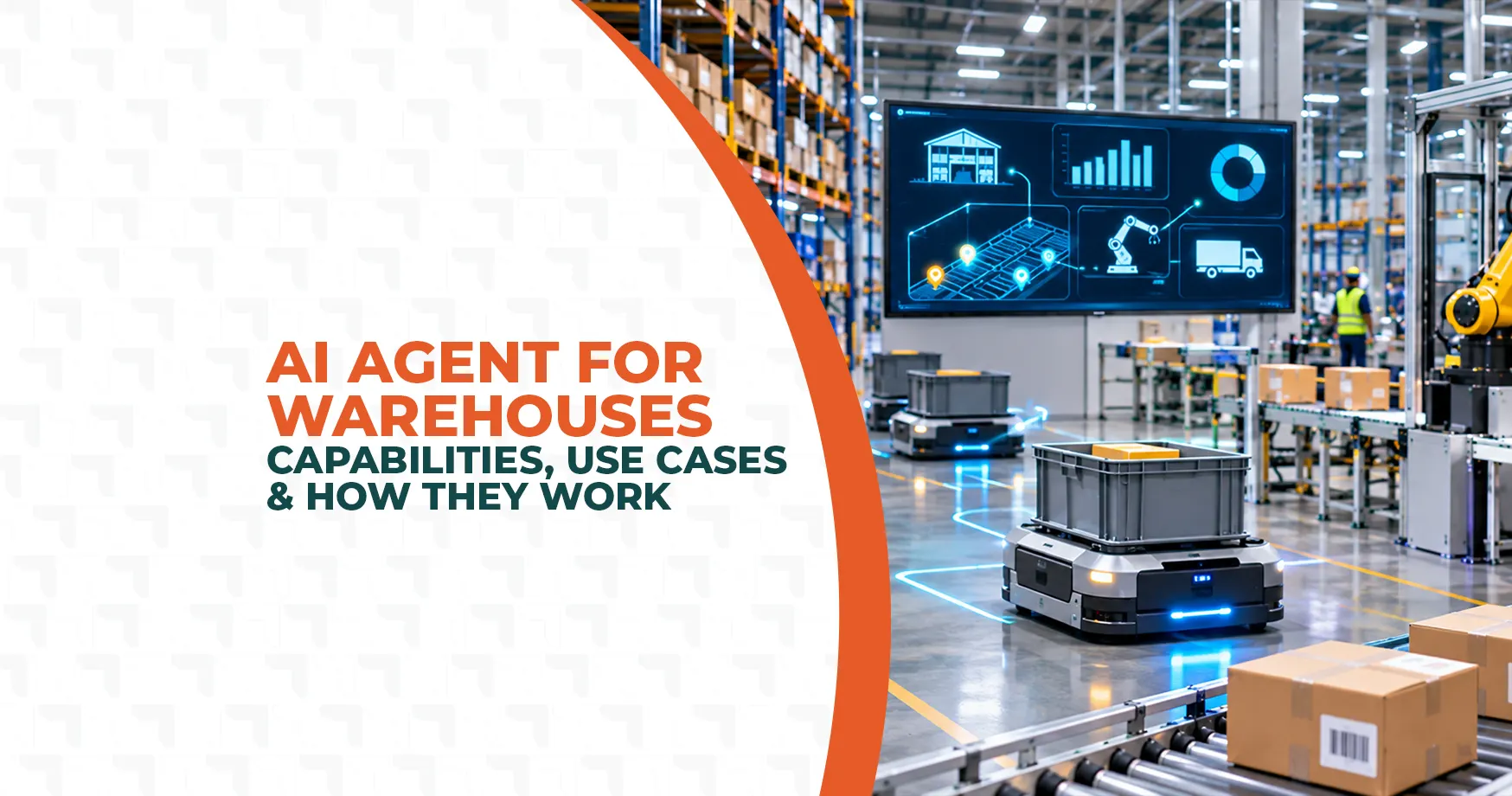
AI Agent for Warehouses: Capabilities, Use Cases & How They Work
An AI agent for warehouses is an intelligence layer that works on top of the existing WMS and ERP. It digests fragmented data from those systems, together with ground-level signals, to identify root causes, flag emerging risks such as stock gaps and workload imbalances, and guide the next decision. Unlike static dashboards, an AI agent continuously monitors live operations, explains what is driving change, and recommends next-best actions in real time.
Warehouses generate huge volumes of data, but the gap between seeing a problem and acting on it is where most of the operational value gets lost. Decision latency is the actual problem, not data volume.
Dashboards show what happened. Chatbots answer when asked. An AI agent monitors continuously, understands warehouse context, learns over time, and recommends actions proactively.
The category is real, and the evaluation criteria matter more than the demo.
What Is an AI Agent for Warehouses?
An AI agent for warehouses is an intelligence layer that makes sense of logistics, labour, and inventory by digesting fragmented WMS and ERP data.
It differs from traditional tools in four ways: it monitors continuously rather than periodically, it understands warehouse context rather than showing data in isolation, it learns over time rather than staying static, and it recommends next-best actions rather than requiring manual interpretation.
The core value is closing the gap between visibility and action. A dashboard reveals a slowdown at dock 3; an AI agent identifies which orders are affected, why the slowdown is happening, and what to redeploy first. That difference is where operational value is won or lost across a shift.
Capability
Monitoring
Context
Root cause
Action
Learning
Dashboards
Periodic, manual review
Data shown in isolation
Manual interpretation
Human decides
No continuous learning loop
AI Agent
Always-on, continuous
Understands WMS, ERP, edge signals
Detects deviations and explains RCA
Recommends next-best actions
Learns from patterns, feedback and outcomes
Key Capabilities and Use Cases of Warehouse AI Agents
Warehouse AI agents are being applied across five capability clusters. Root cause analysis is where an agent differs most from a dashboard, and it is the capability BCI NAVI is built around. Not every agent covers all five: NAVI’s published capabilities centre on root cause analysis, early detection of shifts in flow and inventory, and anticipating stock gaps and workload imbalances.
Labour Management
Identifies where staffing no longer matches demand, such as excess labour in one zone while another faces urgent fulfilment pressure, and recommends where to redeploy people mid-shift. The agent uses live WMS order status and staffing data so that a supervisor does not have to piece the picture together manually. In NAVI, this maps to its ability to recognise workload imbalances early and recommend the response.
Wave Planning
Surfaces order issues such as short-inventory scenarios, pinpoints the impacted items and recommends specific paths forward. The agent shows which orders are at risk, why, and what mitigation options exist, before the shortfall becomes a customer-facing miss. In NAVI, this maps to its ability to anticipate emerging risks such as stock gaps.
Root Cause Analysis
Traces operational issues across inbound, inventory, and outbound flows, connecting signals into clear explanations of what went wrong and why. This is where AI agents differ most from dashboards, and the capability builds on the same manufacturing traceability discipline that makes shop-floor RCA possible.
Document Processing
Automatically ingests, parses, and rationalises unstructured data like invoices and freight bills, checking for anomalies in seconds rather than hours. The document layer connects into the broader inventory picture, which is what RFID in inventory management also builds. This is a use case across the category, not a capability listed for BCI NAVI.
System Orchestration
Connects disparate systems (IoT, safety cameras, robotics) to enforce safety, monitor facility health, and trigger proactive alerts. The orchestration layer is where the broader connected warehouse robotics plays out at operational scale. This is a use case across the category, not a capability listed for BCI NAVI, which operates in read-only mode.
How AI Agents Work With Your WMS
The most common buyer question is how an AI agent connects to what is already running. The best agents connect as a read-only layer on top of the existing WMS, without disrupting or modifying existing operations. This addresses the primary buyer fear directly: disruption to current workflows.
AI agents combine WMS transactional data with ground-level signals (scan events, IoT sensors, edge data) to build a complete operational picture.
The agent is only as good as the data feeding it, which is why barcode and RFID scan data is the ground truth the agent reasons over. The mechanics of that capture layer come down to what RFID is and how it feeds the WMS transactional record.
Enterprise deployment requires security (encryption, role-based access), scalability across multiple sites, and integration with existing WMS and ERP platforms. These are the criteria most enterprise procurement teams filter on before capability evaluation begins. Detailed operational patterns for the underlying warehouse discipline sit in warehouse management tips.
BCI NAVI: An AI Agent Built for Warehouse Operations
Bar Code India (BCI) built NAVI as a warehouse AI agent to close the gap between visibility and action. It continuously analyses live operations on top of the existing WMS, identifies root causes, detects shifts in flow and inventory, and guides corrective actions in real time. Built in India, for India, NAVI was announced in April 2026.
Continuous Monitoring
NAVI tracks live activity across the warehouse continuously, surfacing what matters as it changes rather than after the fact. This shifts the operational picture from periodic dashboard review to always-on situational awareness.
Root Cause Identification
Root cause identification is core to NAVI: it traces issues across inbound, inventory, and outbound flows and produces clear explanations of what went wrong and why. This is the capability that separates it from tools that show data without interpreting it.
Early Detection and Anticipation
NAVI surfaces changes in velocity and operational patterns before they affect performance, and recognises emerging risks such as stock gaps and workload imbalances so teams can respond ahead of time. Its next-best-action recommendations go beyond describing what happened to what to do about it.
Context from WMS, ERP and Edge Signals
NAVI combines ground-level signals with warehouse system data, understanding WMS, ERP and edge signals together, so that what it reports reflects the whole operation rather than one system’s view of it.
Learning Over Time
NAVI adapts to each operation, learning from patterns, decisions and outcomes to refine its guidance. BCI describes this as in-context learning: the agent continuously improves from past queries and usage.
Read-Only Integration
NAVI connects to the existing warehouse management system as a strictly read-only, secure layer, accessed through curated views. It does not write, modify or delete data, so existing operations stay stable. It is optimised for BCI WMS and compatible with other WMS platforms. Data protection uses TLS in transit and AES-256 at rest, with JWT authentication, role-based access control and ISO 27001-aligned practices. User credentials and bulk inventory data are never shared with the AI; only query intent and schema-level metadata are processed. NAVI uses retrieval-augmented generation to fetch only the most relevant data for each query, on top of a leading large language model for intent parsing.
Built for Multi-Site Operations
NAVI provides a centralised dashboard with a unified view across warehouse locations, so performance metrics can be compared and trends spotted across the network from one place.
Pilot and Scale
NAVI is deployed on the existing WMS in weeks, without disrupting current operations. Teams measure the impact, keep what works, and scale only when the value is clear. BCI is offering a 90-day pilot to a limited first cohort of five customers, for focused implementation and support. Visibility beyond the warehouse, across the wider network, sits with BCI’s supply chain control tower solution.
Conclusion
AI agents are moving warehouses from reactive dashboards to proactive, always-on intelligence. The decision-latency problem, not data volume, is what they solve. The best agents connect as a read-only layer on the existing WMS, understand warehouse context, and recommend next-best actions in real time.