
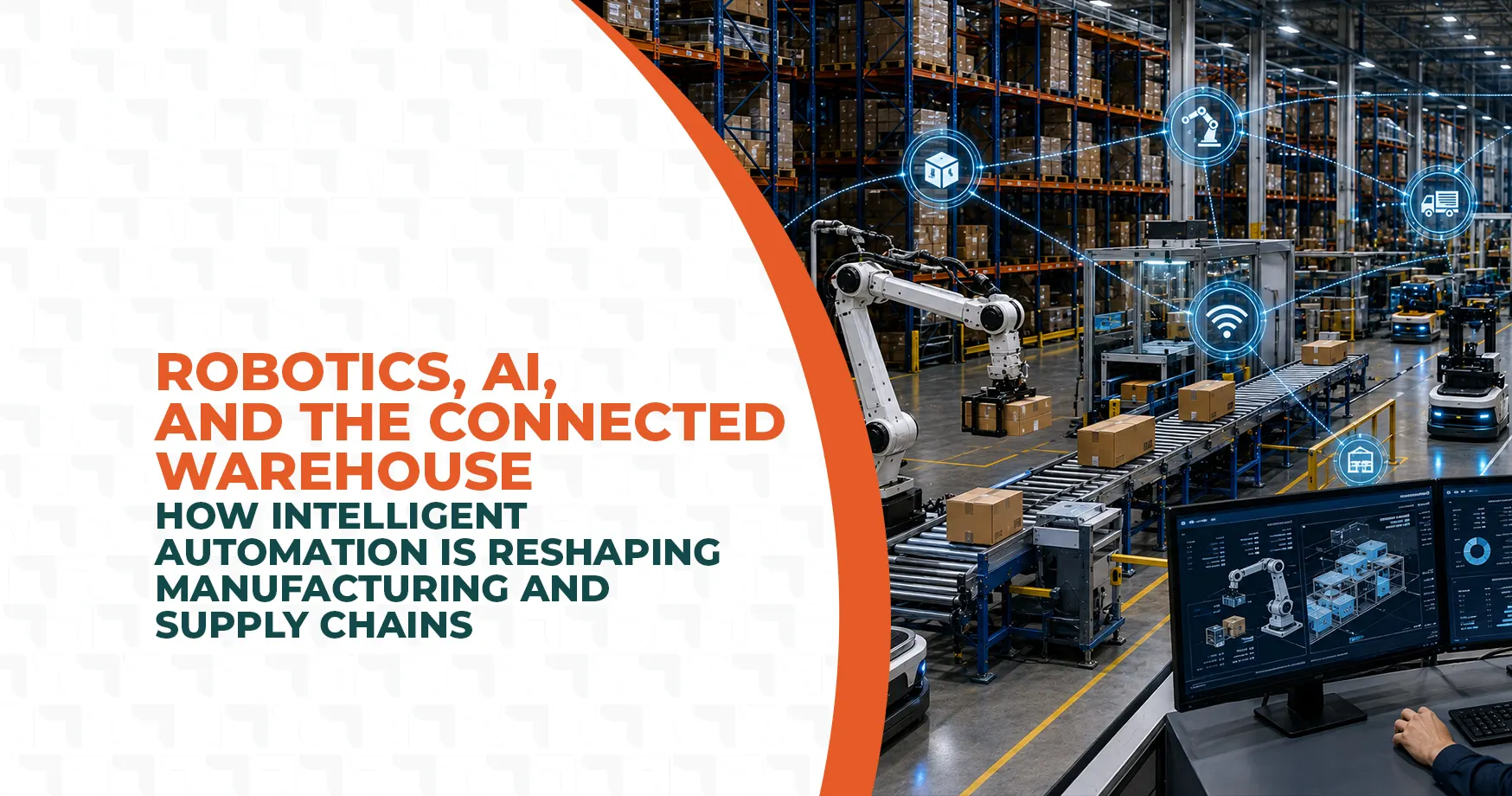
Robotics, AI, and the Connected Warehouse: How Intelligent Automation Is Reshaping Manufacturing and Supply Chains
The future of manufacturing and warehousing is not being shaped by a single technology.
It is being shaped by the convergence of robotics, artificial intelligence (AI), machine vision, autonomous systems, warehouse intelligence, and human expertise.
For years, industrial automation focused on improving individual processes. Conveyor systems accelerated movement. Warehouse management systems improved control. Automated equipment increased throughput and consistency.
Today, however, organizations are looking beyond isolated automation initiatives.
At Bar Code India (BCI), conversations with manufacturers, warehouse operators, and supply chain leaders increasingly point to a common objective: building connected operations where technologies work together to improve agility, efficiency, and resilience.
This shift marks the beginning of a new chapter in industrial transformation.
The Warehouse Has Become a Strategic Growth Engine
Warehouses were once viewed primarily as storage and distribution facilities.
Today, they play a far more strategic role.
Growing order volumes, expanding product portfolios, increasing customer expectations, and supply chain volatility have placed unprecedented pressure on warehouse operations.
Organizations are expected to move inventory faster, fulfill orders more accurately, optimize space utilization, and maintain operational continuity despite ongoing disruptions.
Meeting these expectations requires more than traditional automation.
It requires intelligent systems capable of adapting to dynamic operating environments.
This is why technologies such as Autonomous Mobile Robots (AMRs), Automated Storage and Retrieval Systems (ASRS), collaborative robots (cobots), machine vision, robotic guidance systems, and AI-powered platforms are becoming increasingly important across manufacturing and logistics environments.
The Rise of Robotics in Modern Warehouses
Robotics is rapidly moving from pilot projects to mainstream operational strategy.
AMRs are transforming material movement by navigating warehouse environments autonomously and transporting inventory between operational zones.
ASRS technologies are helping organizations maximize storage density while improving retrieval speed and inventory accessibility.
Cobots are enabling closer collaboration between people and machines by assisting with repetitive, physically demanding, or precision-driven tasks.
These technologies are helping organizations improve throughput, reduce manual intervention, and create more scalable warehouse operations.
However, robotics alone is not the story.
The real transformation begins when robotic systems become part of a larger operational ecosystem.
Why Robotic Guidance Is Emerging as a Critical Capability
One of the most significant advancements in warehouse automation is the evolution of robotic guidance systems.
For a robot to operate effectively, it must be able to understand its environment.
It must identify objects, determine their position, recognize orientation, and decide how they should be handled.
This capability is made possible through the combination of machine vision, 2D and 3D imaging technologies, depth sensing, AI-powered image recognition, and advanced software algorithms.
Together, these technologies allow robotic systems to perform tasks that were previously difficult to automate, including:
- Bin picking
- Depalletizing
- Item sorting
- Material handling
- Quality inspection
- Order fulfillment operations
As robotic guidance technologies continue to mature, they are expanding the practical applications of warehouse automation and enabling greater operational flexibility.
AI Is Becoming the Intelligence Layer
While robotics is transforming physical execution, AI is increasingly enhancing operational intelligence.
Modern warehouses generate vast amounts of data related to inventory movement, resource utilization, workflow performance, fulfillment accuracy, and operational efficiency.
The challenge is no longer collecting information.
The challenge is understanding it.
AI-powered systems are helping organizations identify bottlenecks, optimize workflows, improve forecasting, and support faster operational decision-making.
In many ways, AI serves as the intelligence layer that helps organizations derive greater value from automation investments.
As robotics adoption increases, the relationship between automation and intelligence will become even more important.
The Power of Convergence
What makes today's automation landscape fundamentally different is the convergence of multiple technologies.
Consider a modern warehouse environment.
An ASRS retrieves inventory from storage.
An AMR transports materials across the facility.
A robotic picking system uses machine vision to identify and handle products.
A cobot supports packing or assembly activities.
AI analyzes operational performance and recommends process improvements.
Warehouse software coordinates workflows and provides visibility across the operation.
Each technology performs a specific function.
The value emerges when they work together.
From BCI's perspective, this convergence is one of the most important developments shaping the future of industrial operations. The conversation is no longer centered on individual technologies, but on how multiple systems can operate as part of a connected ecosystem that supports business objectives.
Human Expertise Remains Central
Despite rapid advances in robotics and automation, people remain at the center of industrial operations.
Technology can improve execution, speed, and accuracy.
Human expertise provides judgment, adaptability, and strategic decision-making.
The most successful organizations are increasingly focusing on collaboration between people and intelligent systems rather than replacement.
This is particularly evident in the growing adoption of cobots, which are specifically designed to support human workers while improving productivity and consistency.
The future warehouse is not autonomous.
It is collaborative.
Building the Next Generation of Industrial Operations
The next decade of manufacturing and supply chain transformation will be defined by integration.
Robotics will improve execution.
Machine vision will improve perception.
AI will improve decision-making.
Warehouse platforms will improve coordination.
People will provide expertise, oversight, and adaptability.
Together, these capabilities will create more responsive, scalable, and resilient operations.
At BCI, we believe the future belongs to organizations that can successfully bring these elements together. The goal is not simply to automate more processes, but to build connected operational ecosystems where technology and human expertise work in harmony to drive long-term business value.
That is the direction in which manufacturing and warehousing are evolving—and it is likely to define the next generation of industrial performance.