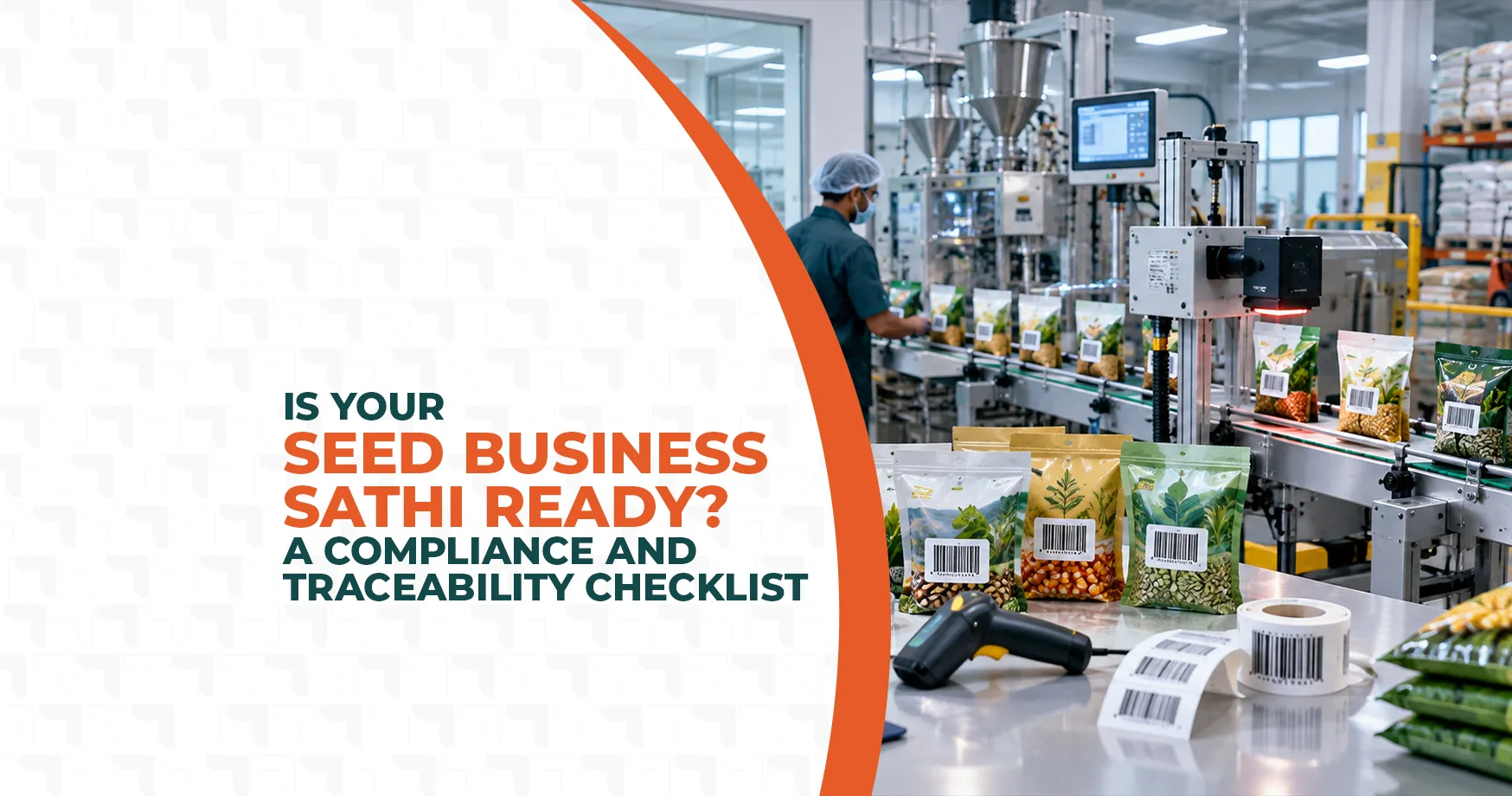
Is your seed business SATHI ready? A compliance and traceability checklist
The QR code mandate for seed packets is already live. For seed businesses, that changes the pace of daily operations fast. Labelling, validation, and portal linkage are no longer side tasks. They sit at the center of compliance.
The pressure is not just about printing a QR code. Every packet must carry the right code, and it must connect to the SATHI portal. Trial runs take time. Team training takes time. Packaging changes take time. If those pieces are still waiting, the rollout timetable is already tighter than it should be.
This checklist is for decision makers who need a practical view. It covers what the mandate requires, where delays usually occur, and how our track and traceability approach helps seed manufacturers move faster.
What does the SATHI-ready mandate actually require?
The mandate is straightforward on paper. Every seed packet must now carry a QR code, and it must be integrated with the SATHI portal. For packets over 100g, printed instructions are also required. The rule applies to all seed companies, and it is effective immediately.
That means compliance is not only a packaging issue. It touches design, printing, validation, and information flow. If one link fails, the packet can miss the mark. That creates risk for distribution, penalties, and brand integrity.
What the packet must support
A compliant seed packet should be ready for:
- QR code printing on the packet
- SATHI portal integration[1
- Printed instructions for packets above 100g
- Vernacular PoP content linkage
- Validation before enforcement and launch
Seed traceability also matters beyond the label.
Where do most seed businesses get stuck?
Most delays do not come from one big technical issue. They come from several smaller ones landing at once. Label design, hardware readiness, portal integration, and trial runs all need to line up.
Packaging teams often start too late. Operations teams often assume printing is the only change. IT teams may not have the integration work scoped early enough. Then the deadline gets closer, and the team is still working through validation.
That is why a compliance checklist helps. It turns a broad mandate into a sequence of tasks. It also makes gaps visible before they become bottlenecks.
Common weak points to test now
- Are QR labels designed for compliant printing?
- Are printers and scanners ready in-house?
- Can warehouse teams scan and validate efficiently?
- Has SATHI portal integration been planned?
- Have full trial runs been completed before enforcement begins?
What should your SATHI readiness checklist include?
A useful checklist should cover the entire flow, not just the label. BCI’s offering around the mandate includes SATHI portal integration, updated packaging with QR codes, label printing software and hardware, and full trial runs before enforcement begins.
That matters because compliance lives in execution. A design file alone does not protect your shipment. A printed label alone does not assure traceability. The process has to work at scale.
1) QR label design and compliant printing
Your labels need to support compliant QR codes and, where required, QR plus 1D barcodes. BCI also supports QR label design and compliant printing. For insecticide packaging, the mandate specifies QR content such as a unique identifier or GTIN, batch number, manufacturing date, expiry date, and a web link or URL upon scanning.
2) Warehouse scanning and validation
Scanning is not a back-office extra. It is part of the control point. BCI includes scanning and WMS-based validation, along with validation tools and seamless system integration. In regulated supply chains, that kind of verification helps reduce manual error and support traceability.
3) Portal integration and system readiness
SATHI portal integration is a core part of the response. BCI also notes standard and pre-built connectors for ERP and third-party systems in its Track and Trace Solution for regulated manufacturing environments. That kind of integration support is useful when the label data must flow cleanly across systems.
4) Trial runs before enforcement
Do not wait for the deadline to test the process. BCI explicitly points to full trial runs before enforcement begins. That is sensible. Trials expose label issues, scanning problems, and process gaps before they become compliance failures.
How does track and traceability fit into seed compliance?
The mandate is about more than appearing ready. It is about building traceability that can stand up in real operations. BCI has enabled traceability solution for many companies in agriculture, FMCG, and manufacturing. That experience matters when seed businesses need both compliance and process control.
A Track and Trace approach can help teams see how information moves from packing to distribution.
Why that matters for seed manufacturers
Seed operations often span multiple sites. That makes consistency harder. It also makes label governance more important. Once packets move across plants and warehouses, any mismatch becomes harder to catch.
BCI’s Track and Trace Solution for regulated manufacturing includes cloud-based software, printers and scanners, QR code labels, and analytics dashboards. It also supports robust validations at every stage, advanced data analytics, aggregation and traceability, and labelling compliance. Those elements support a more controlled compliance process.
Compliance is easier when print, scan, and data flow work as one process.
What does BCI offer to seed businesses preparing now?
BCI’s seed compliance support is built around the mandate itself. The offer includes SATHI portal integration, updated packaging with QR codes, label printing software and hardware, full trial runs, machine vision systems for scanning and validation, QR label design, and in-house printing hardware.
For seed businesses, that is useful because it combines the front end and the back end. Design alone is not enough. Printing alone is not enough. Scanning without integration is not enough.
BCI also positions its solutions for full support across multiple plants and warehouses. That matters for businesses that do not operate from one site only. A larger footprint means more touchpoints, and more points where compliance can slip.
What is the business value beyond compliance?
Compliance is the trigger. Traceability is the payoff. The insecticides mandate shows how QR codes can support consumer safety, secure regulatory compliance, prevent counterfeiting and pilferage, retain brand integrity, enhance operational efficiency, and improve quality control.
The same logic applies to seed packets. When data is visible and validated, teams can respond faster. When labels are standardized, operations become easier to control. When traceability is built into the process, audits are less painful.