
RFID vs Barcode Technology: Key Differences, Benefits, and Applications
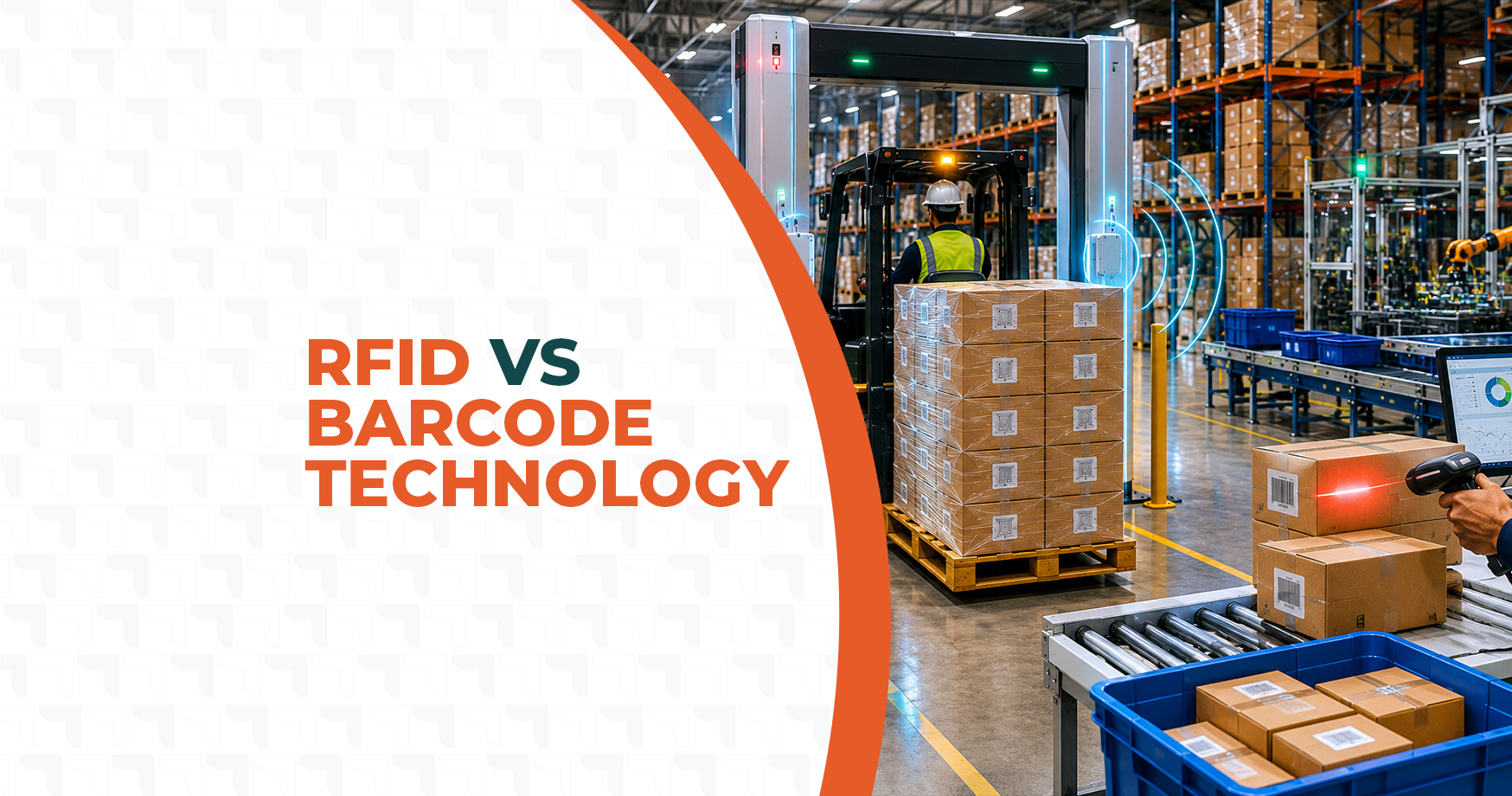
RFID vs barcode technologies represent two fundamentally different methods of identifying and tracking items across manufacturing, supply chains, warehouses, retail environments, and asset-intensive industries. While barcodes have been the backbone of product identification for decades, the rise of automation, real-time visibility, and compliance requirements is pushing companies toward RFID adoption. Choosing between the two, or designing a hybrid model, depends on operational volume, automation needs, accuracy demands, and long-term digital transformation goals.
Barcodes rely on optical scanners and printed labels, making them cost-effective and simple for everyday item identification. RFID, on the other hand, uses radio waves to read multiple tags simultaneously without line-of-sight, offering speed, automation, and deeper intelligence at a higher initial cost.
This guide breaks down how each technology works, compares capabilities feature-by-feature, highlights where RFID advantages are most meaningful, and provides clear recommendations for retail, manufacturing, logistics, pharma, and hybrid deployments.
What is Barcode Technology?
Barcode technology uses printed black-and-white lines or patterns that store encoded data about an item. Optical scanners read these patterns and convert them into digital information for identification, pricing, and tracking. Barcodes enable fast, reliable item-level recognition across retail, warehousing, logistics, healthcare, and manufacturing environments.
How Barcodes Work (The Process)
- Barcode creation: Product data encoded into line patterns
- Label printing: Applied on packaging, labels, or surfaces
- Scanner activation: Optical scanner emits a light beam
- Pattern detection: Reflected light captured by scanner
- Data conversion: Decoder converts patterns to digital data
- System integration: Sent to POS, WMS (warehouse management system), or ERP
Barcode Technology Types
1D Barcodes: UPC-A, Code 128, Code 39, EAN
2D Barcodes: QR Code, Data Matrix, PDF417
What is RFID Technology?
RFID (Radio Frequency Identification) uses radio waves to identify and track items wirelessly. As compared to barcodes, RFID does not require a line-of-sight workflow and can read hundreds of tags simultaneously. This makes RFID ideal for high-volume operations, automated warehouses, real-time visibility, and industries with strict traceability requirements.
RFID Frequency Bands (Selection Framework)
- LF (10cm), HF (30cm–1m)
- UHF (3–12m; industry standard)
- Active RFID (100m+).
UHF is ideal for manufacturing, logistics, warehousing due to long range and fast scanning.
How RFID Works (Technology Process)
- Reader emits radio waves
- Tag receives signal and activates
- Tag transmits data back
- Reader captures multiple tags simultaneously
- Middleware processes clean data
- Solution/ERP updates in real time
- Automation triggers workflows
RFID Use Cases Across Industries
- Logistics: Pallets, shipping, delivery verification, returns
- Manufacturing: WIP, tools, components, genealogy
- Pharma: Serialization, cold chain, recalls, patient safety
- Retail: Inventory accuracy, shrinkage reduction
- Food: Farm-to-fork traceability, cold chain validation
- Automotive: Serialization, supplier visibility, RTI tracking
RFID vs Barcode: What’s the Difference?
RFID and barcode systems both address item identification and tracking, but the way they operate and the scale at which they perform are fundamentally different. Barcodes remain ideal for low-volume, cost-sensitive operations with minimal automation requirements. RFID, however, outperforms in environments that demand speed, real-time visibility, multi-point track and trace, and compliance-driven traceability.
Your choice depends on volume, automation goals, budget, and regulatory requirements.
Comparison Table

Is RFID Better Than Barcode?
Barcodes remain reliable for simple, low-volume tasks, but RFID delivers significant advantages for businesses that operate at speed, handle large SKU volumes, or require continuous automation and compliance-ready traceability. For manufacturing, pharma, automotive, FMCG, and logistics, RFID solves the scalability, accuracy, and visibility limitations inherent to manual barcode systems.
Real-Time Tracking and Visibility
Barcode Limitations
- Requires manual scanning at each touchpoint across docks, warehouses, or production stations
- Updates reflect only after an operator scans, creating delays of minutes to hours
- No live tracking while items move between locations
- Inventory status depends entirely on operator discipline
- Gaps in scanning create blind spots that ripple through the supply chain
RFID Upgrade
- Automated fixed readers track items continuously with zero human effort
- Live dashboards show exact SKU movement as it happens
- Eliminates blind spots between facilities or checkpoints
- Real-time tracking links can be shared with customers
- Enables proactive supply chain control instead of reactive corrections
Manufacturing Advantages
- Granular WIP visibility, know each component’s exact station
- Early detection of bottlenecks before they disrupt production
- Multi-location synchronization, real-time oversight of 10+ sites
- Data-driven planning: reorder points, cycle times, and flow analytics
- Example: India’s largest glass solution manufacturer, serving the automotive sector, tracks 38,000 pallets with 100% accuracy across 13 locations, using Bar Code India’s RFID enabled Asset Intelligence Platform.
Bulk Reading Capability
Barcode Limitation
- One item per scan = inherently slow (max ~1 unit/second)
- Fatigue and repetition increase errors over time
- Impossible to accelerate without doubling staff
RFID Capability
- Reads 100+ tags simultaneously using anti-collision protocols
- Adds performance without adding workforce
- Ideal for conveyor lines, pallet movement, and high-density SKUs
Manufacturing Impact
- Instant pallet verification, no box opening
- Inbound validation 10x faster
- WIP scanning for 3,000+ units/hour without human intervention
No Line-of-Sight Needed
Barcode Limitation
- Item must face scanner correctly
- Requires unpacking, tilting, and repositioning
- Opaque packaging blocks scans
- Highly inefficient for sealed goods or bulk pallets
RFID Advantage
- Reads through cardboard, plastic, shrink-wrap, sealed crates
- Tags can be placed inside packaging or embedded in product
- No need to orient or expose the item at all
- Perfect for high-speed mechanical flow and closed-box operations
When to Use Barcode vs RFID
Selecting between barcode and RFID is an operational decision tied to volume, compliance, automation goals, and the cost of errors. The framework below helps teams choose the right identification system based on real-world conditions.
Strategic Recommendation Table
RFID and Barcode Integration in Modern Supply Chains
Modern supply chains rarely operate on a “barcode OR RFID” principle. The most sophisticated operations leverage both technologies strategically, creating a hybrid model that balances cost, accuracy, and automation.
Real-World Scenario: Automotive OEM Tier 1/2 Supplier
Supplier Manufacturing (Parts Plant)
- RFID tags embedded on individual parts during production
- Tags store quality records and traceability data
- Direct linkage between part, testing, and compliance info
Logistics Hub (3PL)
- Pallet-level RFID scanning validates shipment contents automatically
- Case-level barcode enables customer-side verification
Customer Manufacturing Line
- Barcode confirms purchase order match on receipt
- RFID pallet scan verifies inventory in seconds
- RFID triggers automated assembly line deployment and quality validation
Result: Full supply chain transparency from supplier to end product with minimal manual intervention.
BCI Integration Advantage
1. No Vendor Lock-In
- Supports both RFID and barcode hardware
- Flexible deployment: choose technology per touchpoint
- Gradual RFID adoption as ROI justifies expansion
2. Seamless Data Handling
- BCI WMS supports both barcode and RFID solutions natively, no separate middleware needed
- Single dashboard shows real-time combined data
Outcome: A scalable, cost-efficient, and risk-managed digital transformation approach, not an all-or-nothing investment
Future of Identification Technologies
The future of identification lies in integration, not replacement. RFID and barcodes will increasingly connect with AI, blockchain, IoT, and digital twins to create intelligent, transparent, and proactive supply chains.
- AI-Powered Insights: Automatically detect anomalies, forecast demand, and prevent theft.
- IoT Sensor Integration: Monitor temperature, humidity, pressure, and handling in real-time.
BCI platforms unify these technologies, enabling smarter, faster, and safer operations.
Both Technologies Have Their Place
RFID and barcode each play a critical role in modern supply chains. The choice isn’t about which is “better” universally, but which aligns with your operational needs, volume, and automation goals.
With over 30 years of manufacturing automation expertise in India, Bar Code India offers neutral, practical guidance, recommending barcode or RFID solutions strictly based on ROI.
Our unified solution stack integrates print-and-apply dual labeling, WMS, and Track & Trace, delivering end-to-end visibility across your supply chain. From initial needs assessment and pilot implementation to full-scale deployment, optimization, and continuous improvement, we provide comprehensive support.
Unsure which technology fits your operation?
Connect with BCI to understand more.