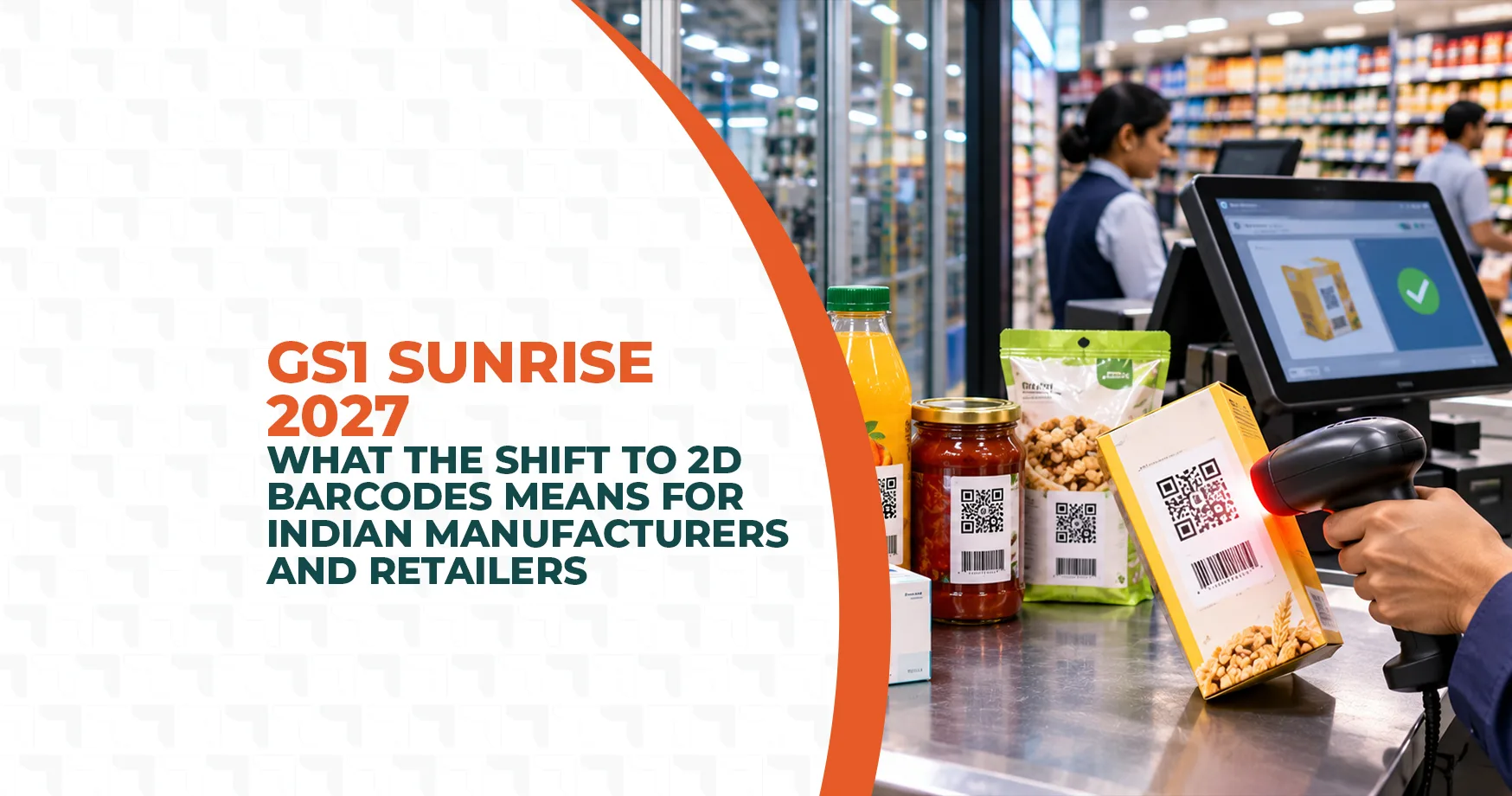
GS1 Sunrise 2027: What the Shift to 2D Barcodes Means for Indian Manufacturers and Retailers
GS1 Sunrise 2027 is a global industry target for retailers to be able to scan 2D barcodes at the point of sale (POS) by the end of 2027, alongside the 1D barcodes they read today. It is voluntary. It is not a law, and it is not a ban on 1D barcodes.
For manufacturers, the real change is what goes inside the code. A 2D barcode can carry the batch, expiry date and serial number as well as the product number, and it can link to a web page.
This guide explains what is changing, what it means for manufacturers and retailers in India, and what to do first.
What is GS1 Sunrise 2027?
GS1 is the body that sets global barcode standards. Sunrise 2027 is its initiative to get retail POS systems ready to read 2D barcodes by the end of 2027. Pilots are running in 48 countries.
- It is a target for retailers. It does not oblige manufacturers to print 2D codes, and it carries no penalty.
- 1D barcodes are not being retired. During the transition, packs can carry both.
Why the barcode is changing
For about 50 years, the 1D barcode on a pack has done one job: it carries the product number, so a scanner can find the product and its price. It cannot say which batch the pack came from, or when it expires. A 2D code can. That is the idea behind Sunrise 2027.
What changes on the pack
More data in the same space
The 1D barcode on Indian packs (EAN-13, starting with the 890 prefix) carries one thing: the product number, called the GTIN. A 2D code can carry more. Each item is marked by a short GS1 number called an Application Identifier (AI):

Examples are illustrative, not a real product. Price matters in India because a GTIN does not change when the price does, so one product can be on sale at more than one MRP, for example after a revision while old stock is still on shelves. GS1 has no field named “MRP”. Its price fields can carry it, so agree this with trade partners and GS1 India before printing.
An example. A pharmacy sells a strip of tablets whose code carries batch and expiry. If that batch is later recalled, or the strip is past its date, a till that reads the code and holds the recall list can stop the sale. With a 1D barcode, the till sees only the product number, so the same check depends on staff.
Three code types
- GS1 DataMatrix: a compact square code that suits small packs and tight print space.
- GS1 QR Code: the same data in the familiar QR shape.
- GS1 Digital Link QR: a QR code that holds a web address built from the same GS1 numbers. A phone scan opens a brand page, and a retail scanner can read the product number from it.
The choice of code is the manufacturer’s. An ordinary QR code that only opens a homepage is not a GS1 code, so it does not carry the product number in the form retail systems read.
1D and 2D side by side
 What manufacturers should do
A 2D code is only as good as the data behind it. Batch, expiry and serial numbers are created on the production line, so the plant’s systems must generate them accurately before any label is printed. A scanner at the till cannot correct wrong data. With that in mind:
- Labelling software: make sure it can print GS1-compliant 2D codes with the correct AIs. A wrongly built code can fail at the till even if it looks fine. See automated labelling.
- Printers: check that line printers can print sharp 2D codes at line speed. Some may need an upgrade or recalibration.
- Verifiers: a barcode verifier grades print quality, so poor codes are caught before they leave the plant.
- Scanners: receiving, line, warehouse and dispatch scanners need to read 2D codes. Most 2D imagers also read 1D.
- Pack layout: where print space is tight, plan room for both the 1D and the 2D code early, before artwork is final.
What retailers and D2C brands should do
- Checkout: 1D laser scanners cannot read 2D codes. Checkout lanes need 2D imagers.
- Expiry and recall: when batch and expiry are in the code and the POS is set up to check them, an expired or recalled pack can be stopped at the till. This matters most in pharmacy, healthcare, food and other perishables.
- Consumer engagement: a Digital Link QR can open product details, manuals or authenticity information from any phone camera. The scan data that comes back belongs to the brand.
- Talk to suppliers: tell them which codes your POS will read, and ask which they plan to print.
Getting ready: five steps
- Decide what the code will carry (for example GTIN, batch, expiry, serial and, if agreed, price) and which code type to use.
- Check your printers, labelling software and scanners for 2D readiness.
- Upgrade scanners, POS and billing systems to read 2D codes and use batch, expiry and price where wanted.
- Print 1D and 2D together. Retire the 1D code only when the trade partners who matter can read 2D.
- Talk to GS1 India early. It issues GTINs and can advise on implementation.
Common mistakes to avoid
- Using an ordinary QR code where the pack must work at retail POS. Use a GS1 DataMatrix, GS1 QR Code or GS1 Digital Link QR.
- Skipping the print-quality check. A code that looks fine can still fail to scan.
- Dropping the 1D barcode too early.
- Leaving MRP handling undecided. Agree it with trade partners first.
- Starting with label design instead of data. Decide what the code carries first.
Exporting? Other rules ask for the same data
Several export rules need batch-level traceability, which a 2D code can link to. They arrive on different dates:
 These rules have different aims. EUDR and FSMA 204 do not require a particular barcode. They need batch-level records that a code can link to. A manufacturer that builds this data once, at the line, can use it for all of them instead of building it three times.
Conclusion
Sunrise 2027 is a target for retailers, not a deadline for manufacturers. The code type is your choice. The value lies in the data inside the code, and that data is created on the production line. Dual-marking and a hardware check now keep your options open.
Bar Code India (BCI) supplies industrial printers, verifiers, 2D scanners and the software behind them, including manufacturing execution, warehouse management and track and trace.