

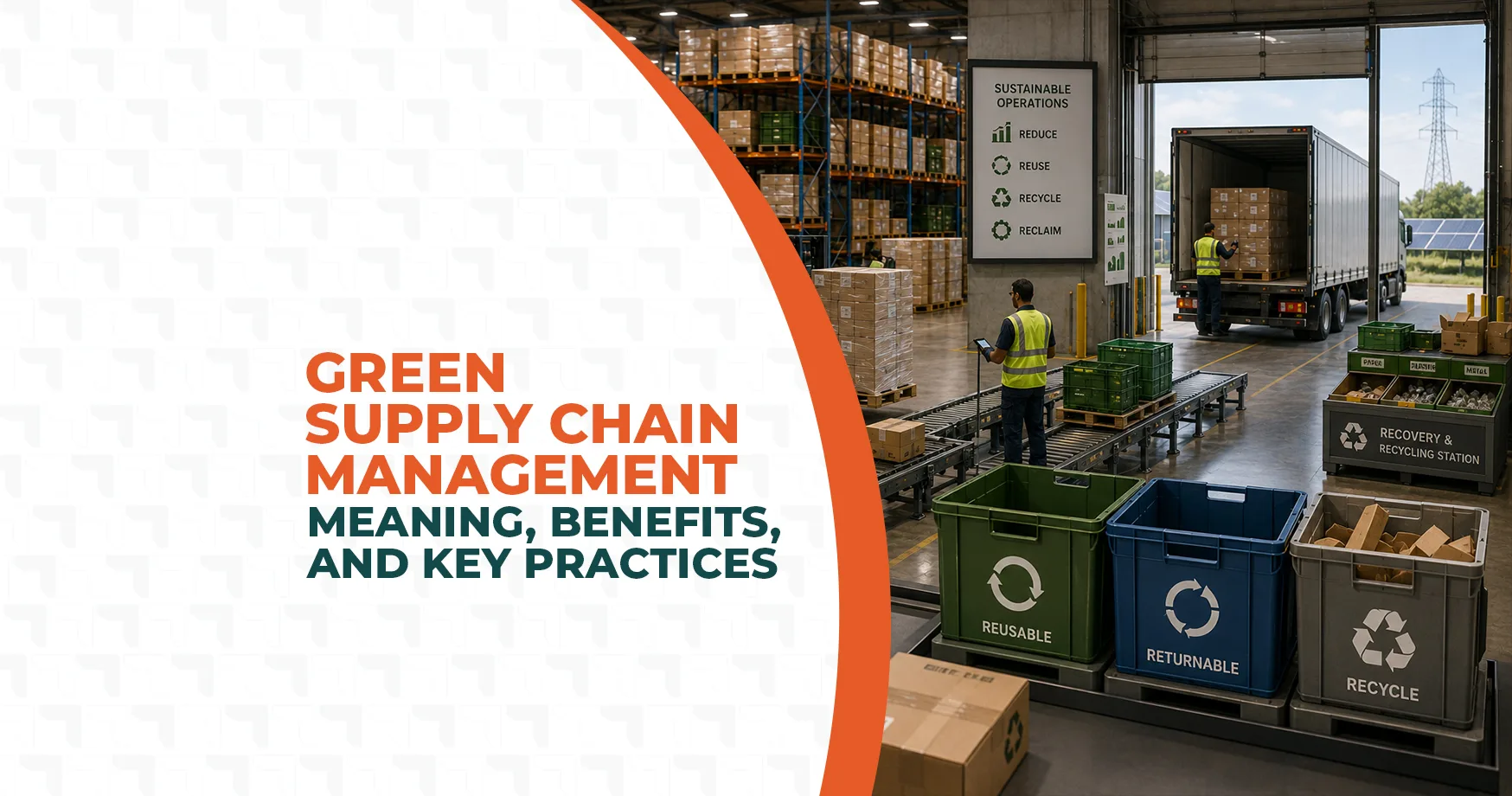
Green Supply Chain Management: Meaning, Principles, Benefits, and Examples
Traditional supply chains were designed primarily for cost efficiency and speed. Environmental impact often remained a secondary concern. Rising emissions, excessive waste, and resource depletion have since exposed the long-term risks of this approach. Regulatory pressure, investor scrutiny, and customer expectations now demand measurable sustainability across operations.
Green supply chain management responds to this shift by embedding environmental responsibility into everyday supply chain decisions. Rather than treating sustainability as a parallel initiative, it integrates resource efficiency, emissions control, and waste reduction directly into planning and execution. Technology and data play a central role by making environmental impact visible, measurable, and controllable across sourcing, manufacturing, warehousing, and logistics.
What Is Green Supply Chain Management?
Green Supply Chain Management (GSCM) is the integration of environmental thinking into every stage of the supply chain, right from sourcing and manufacturing to logistics, distribution, and product disposal - to reduce environmental impact, conserve resources, and minimize waste and emissions.
• Applies sustainability principles such as reduce, reuse, recycle, and reclaim across operations.
• Encourages eco-friendly supplier selection, green product design, and efficient transportation.
• Uses technology and data to optimize energy consumption, material usage, and emissions.
• Supports regulatory compliance while improving long-term operational resilience.
Green supply chain management extends responsibility beyond individual processes. Environmental criteria influence procurement decisions, production planning, inventory policies, and transport models. Sustainability becomes measurable through data rather than policy statements.
Collaboration across suppliers, logistics partners, and distributors is essential. Environmental targets only succeed when upstream and downstream partners follow aligned standards. GSCM also supports broader ESG goals by connecting operational execution with reporting and compliance frameworks.
Core Principles of Green Supply Chain Management
Green supply chain management works when environmental goals are built into daily supply chain decisions. These principles guide how materials are sourced, products are made, inventory is stored, and goods are moved.
- Green design: Product and packaging design affect material usage, transport efficiency, and waste generation. Reducing excess packaging, using recyclable materials, and standardizing carton sizes lower material waste and transport emissions.
- Green sourcing: Supplier selection includes environmental compliance, waste handling practices, and energy usage. Procurement teams evaluate suppliers based on sustainability records, not only cost and lead time.
- Green manufacturing: Manufacturing focuses on lowering energy consumption, water usage, scrap rates, and rework. Monitoring resource usage per unit helps identify inefficient processes and improve production efficiency.
- Green logistics: Transportation planning reduces fuel consumption and emissions through route optimization, load consolidation, and efficient warehouse placement. Practices seen in the automotive supply chain show how transport decisions affect emissions at scale.
- Reverse logistics: Returns, recycling, and end-of-life handling are managed through defined processes. This reduces landfill waste and recovers usable materials.
- Life cycle assessment: Environmental impact is measured from raw material sourcing to product disposal. This prevents shifting emissions from one stage to another.
How Green Supply Chain Management Works?
Green supply chain management becomes practical when sustainability is tied to planning, execution, and measurement across sourcing, warehousing, and logistics. It is not a side initiative. It is built into how inventory moves, how materials are stored, and how transport decisions are made every day.
1. Sustainability in planning
Network design, warehouse placement, and inventory policies consider fuel usage, power consumption, and material waste along with service targets. Decisions related to temperature-sensitive storage depend on principles explained in cold chain solution practices, where energy control and product integrity must work together.
2. Data driven execution
Environmental performance cannot be improved without operational data. Inventory records, shipment data, warehouse energy logs, and transport movement data are reviewed to understand where waste and excess consumption occur. Teams rely on live data instead of monthly reports.
3. Collaboration across partners
Suppliers, transporters, warehouses, and distributors follow common sustainability metrics. Shared data ensures that packaging methods, shipment planning, and storage pactices follow the same environmental guidelines.
4. Continuous optimization
As demand patterns change, inventory positions, transport routes, and packaging loads are adjusted. This prevents unnecessary storage, excess transport runs, and underutilized shipments.
Benefits of Green Supply Chain Management
Green supply chain management delivers value only when sustainability decisions change how warehouses, transport, and inventory are actually run. Benefits show up through tighter controls, fewer handoffs, and lower waste across daily operations.
1. Transport efficiency
Shipment consolidation and route optimization reduce fuel consumption and idle mileage. Fewer partial loads and fewer emergency dispatches directly cut emissions and logistics cost volatility.
2. Packaging reduction
Standardized carton sizes and reusable containers improve pallet utilization. Reduced void space lowers material usage and minimizes disposal volume across distribution centers.
3. Energy control
Measuring energy consumption per pallet handled exposes inefficient storage zones. Lighting, cooling, and equipment usage can then be adjusted without disrupting throughput.
4. Compliance readiness
Digitized waste, packaging, and emissions records simplify environmental audits. Compliance shifts from manual reconciliation to system driven reporting.
5. Cost stability
Lower dependency on expedited transport and excess storage protects operations against fuel price swings and regulatory cost increases.
6. Waste reduction
Controlled handling, optimized layouts, and accurate inventory movement reduce damage, scrap, and reverse logistics volume.
Examples of Green Supply Chain Practices
Green supply chain execution becomes visible when operational decisions reduce unnecessary movement, storage, and material usage instead of relying on offset programs.
1. Electric fleets
Urban deliveries using electric vehicles reduce fuel dependency and lower emissions in dense distribution zones.
2. Smart packaging
Packaging redesign improves stacking strength and load density, reducing total trips required for the same shipment volume.
3. Renewable power
Warehouses using on site solar reduce daily grid electricity consumption for lighting and material handling equipment.
4. Recycling loops
Returned packaging and damaged materials are sorted, recovered, and reused, reducing landfill dependency.
5. Route optimization
Dynamic routing reduces empty kilometers and repeat trips across regional delivery networks.
A practical illustration appears in the supply chain optimization case study, where fragmented data caused excess movement and handling. Centralized visibility reduced redundant transport and improved resource utilization across facilities.
Key Performance Indicators (KPIs) for GSCM
Green supply chain performance becomes meaningful only when environmental indicators are reviewed together with cost, service levels, and operational KPIs during monthly reviews. These metrics translate sustainability into measurable warehouse, transport, and sourcing decisions.
1. Emissions intensity
Carbon emissions per shipment, per route, and per ton kilometer help identify inefficient transport legs, poor load planning, and unnecessary vehicle movement across the network.
2. Energy intensity per handling unit
Energy consumed per pallet moved, stored, or picked reveals high consumption zones in warehouses. This supports lighting optimization, equipment scheduling, and layout correction.
3. Packaging material footprint
Corrugate, plastic, and filler material used per order exposes overpacking practices, poor carton standardization, and excess dunnage across dispatch operations.
4. Waste diversion rate
Percentage of material diverted from landfill through reuse, recycling, or recovery shows how effectively reverse logistics and warehouse waste segregation are functioning.
5. Supplier sustainability compliance
Suppliers are assessed on recyclable packaging use, material sourcing transparency, emission reporting, and adherence to environmental procurement standards.
Best Practices for Implementing GSCM
Green supply chain management becomes effective when sustainability controls are embedded into daily warehouse, transport, and sourcing workflows. Environmental impact reduces when receiving, putaway, picking, packing, and dispatch are executed with measurement and discipline.
1. Target setting at operational level
Environmental goals must map to physical activities such as pallet movement, carton usage, dock utilization, vehicle loading, and storage density. Targets should relate to emissions per shipment, packaging per order, and energy per pallet handled.
2. Data standardization across touchpoints
Data must be captured at receiving, bin allocation, picking confirmation, and dispatch validation. Without consistent scan events and location data, measuring waste, excess handling, and rework becomes impossible.
3. Supplier packaging and inbound discipline
Inbound shipments should follow standardized pallet patterns, reusable containers, and minimal filler material. Dock to stock time, packaging disposal volume, and material segregation must be monitored during receiving.
4. KPI reviews linked to workflow
Environmental KPIs should be reviewed along with order cycle time, picking accuracy, and storage utilization. Excess handling, repeated picking, and poor slotting directly increase energy usage and waste generation.
5. Accurate material and inventory tracking
Using barcoding or RFID technology for every inventory movement reduces misplacement, rehandling, and unnecessary internal transport. Correct bin level accuracy prevents double handling and redundant picking routes.
6. Reusable asset and container visibility
Returnable pallets, crates, and bins must be tracked through asset management solutions to prevent loss and repeated procurement. Visibility into these assets reduces material waste and replacement frequency.
7. Alignment with broader supply chain and inventory controls
A strong foundation in supply chain management and inventory management ensures sustainability is achieved through better execution, not additional processes layered on top of existing inefficiencies.