

Digital Product Passports: What Indian Manufacturers Need to Know
The global manufacturing model is shifting from linear to circular. That sentence has been around long enough to sound abstract, but the EU is now turning it into something concrete.
Every product sold in its market will eventually have to carry its full lifecycle story with it. Where the material came from, what is inside it, what its carbon footprint looks like, how it can be repaired, what happens at end of life.
The Digital Product Passport is the format the EU has picked to make that information legible to regulators, retailers, repair shops, and consumers. For Indian manufacturers selling into the EU, this stops being a sustainability theme and starts being a market-access condition.
Every DPP, however sophisticated the software platform behind it, depends on one physical-world detail: a scannable carrier on the product that opens the passport when read.
What Is a Digital Product Passport (DPP)?
A Digital Product Passport is a standardised digital record that travels with a physical product across its entire life. It stores material composition, origin, carbon footprint, repairability data, hazardous-substance declarations, and recycling instructions in a structured form.
The goal is straightforward: sustainability claims should be verifiable rather than asserted.
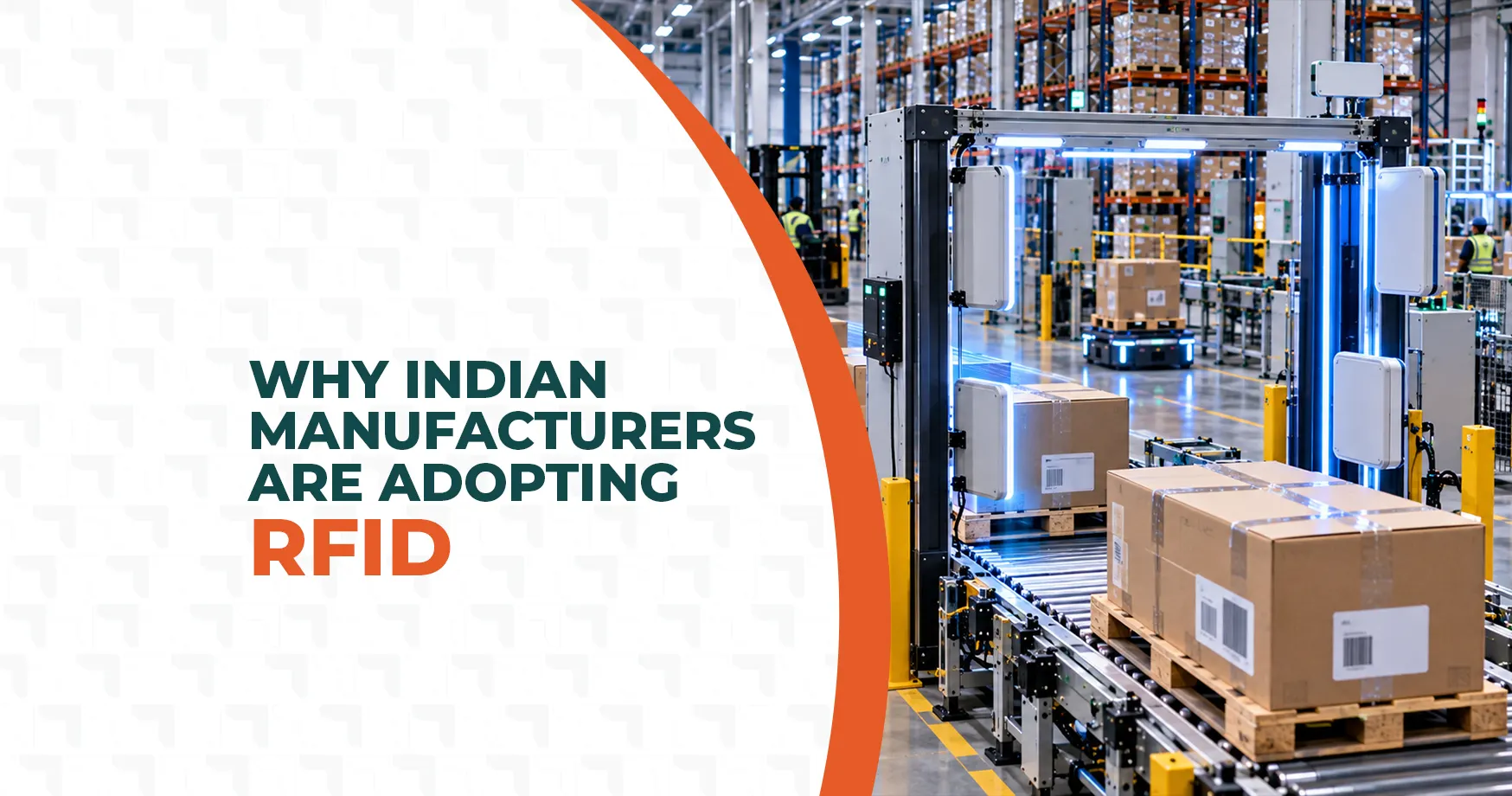
Access to the passport happens through a data carrier on the product, usually a QR code or an RFID tag. Scan the carrier, and the passport opens. The carrier is the bridge; without it, the record is unreachable.
For an Indian manufacturer, DPP operates as an export requirement that kicks in at the EU border. Battery passports under the EU Battery Regulation become mandatory from February 2027.
What Data a Digital Product Passport Stores
A DPP is not a single field. It is a structured record covering several categories necessary for circularity, compliance, and consumer transparency.
Product Specifications
Material compositions, constituents, and the technical standards the product is built to, drawn from bills of materials and supplier declarations.
Origin and Traceability
Upstream supplier records, production locations, and ethical-sourcing evidence across the multi-tier supply chain, which is the same information track and trace systems formally record in manufacturing. For Indian exporters, this is often the hardest part of the data set to assemble, because tier-two and tier-three records are usually captured informally.
Environmental Data
Life cycle assessments (LCAs), embodied carbon footprints, energy use during production, and hazardous-substance declarations. This is the core ESPR sustainability requirement.
Circularity Metrics
Repairability scores, spare-parts catalogues, disassembly instructions, and recycling protocols. These fields shift the product from a one-life object into a multi-life asset.
How a Physical Product Connects to Its Digital Product Passport
The DPP is digital, but the regulator, the retailer, and the consumer all interact with a physical product. The link between them is the data carrier on the product.
This is the layer most DPP discussions skip over, and it is the one that determines whether the whole system works.
Four things make the carrier do its job.
The Data Carrier
The dominant standard is the barcode, applied as a QR code.
RFID is the alternative carrier for higher-value goods and industrial products, and the choice between RFID and barcode depends on throughput, value density, and read-environment constraints. QR and DataMatrix are the standard for consumer-facing products where a phone-scan interaction is expected.
Lifecycle Durability
Years of wear, washing, heat, chemical exposure. Because the DPP is queried at repair, resale, and recycling, a label that fades in twelve months turns the passport into a one-time read.
Application Accuracy
The carrier must be printed or encoded correctly, applied to the right product, and verified inline before it ships. Reliable carrier application at production speed depends on automated labelling systems, since the failure mode is usually a mis-applied or unreadable carrier rather than a poorly-designed data model.
Source Data
Component-level barcode and RFID tracking captures the origin, batch, and material data the passport must contain. This is the same capture layer a track and trace system builds, and it is what a DPP software platform draws from downstream.
BCI's track-and-trace stack sits at this layer, supplying the capture and carrier infrastructure the DPP software platform reads from.
Conclusion
Digital Product Passports are the operating layer of the circular economy, and for Indian manufacturers they are becoming a condition of global market access starting with batteries and textiles.
The passport itself is digital, but it depends on a physical data carrier on the product and on accurate manufacturing data captured at the component level.
If you are preparing an export-manufacturing line for DPP requirements, BCI's track-and-trace practice has worked on the capture and carrier layer across these deployments and can be reached through the warehouse management or related solution pages.