
Why Indian Manufacturers Are Adopting RFID: Drivers, Benefits & Use Cases
Indian factories generate scan volumes their barcode workflows were not built to handle. Automotive component plants on Tier 1 OEM contracts, electronics units feeding the PLI catalogue, and pharma facilities under CDSCO oversight log component movement data faster than line operators can capture manually.
RFID handles that volume through non line of sight reads, automated checkpoint capture, and direct ERP and MES integration. Make in India hardware like BCI Dristi has narrowed the cost gap with imports, putting industrial readers, antennas, not only at the top of the supplier pyramid.
Key Reasons Indian Manufacturers Are Adopting RFID
Five drivers explain why RFID is on procurement plans across automotive, pharma, and electronics in India.
Inventory accuracy
A single reader pass captures hundreds of items at once, replacing manual cycle counts that run for days. ACMA member plants tracking returnable bins between Tier 2 and Tier 1 facilities use it to remove the missed scans that show up at month end audits.
Operational efficiency
Reader output flows into ERP and MES with location and movement data, exposing bottlenecks before they propagate. Material flow on automotive lines under JIT contracts and throughput on high SKU electronics floors are the consistent outcomes reported in Auto Components India and Express Pharma.
Cost and theft
Continuous read coverage cuts shrinkage from theft, misplacement, and unrecorded movement. Multi shift facilities also reduce labour spent on manual entry across receiving, putaway, and dispatch.
OEM compliance
Tier 1 and Tier 2 suppliers run on JIT contracts that increasingly require tag-based traceability, delivery confirmation, and recall-ready data. RFID is a contractual condition for a growing share of large supply agreements.
How RFID Works in a Manufacturing Environment
The RFID setup inside a manufacturing plant runs on three physical components and one integration layer.
RFID tags
Passive tags attach to products, pallets, WIP containers, and assets, emitting a unique code when energised by a reader. Industrial tags are rated for the heat, vibration, and chemical exposure common to Indian manufacturing environments.
Readers and antennas
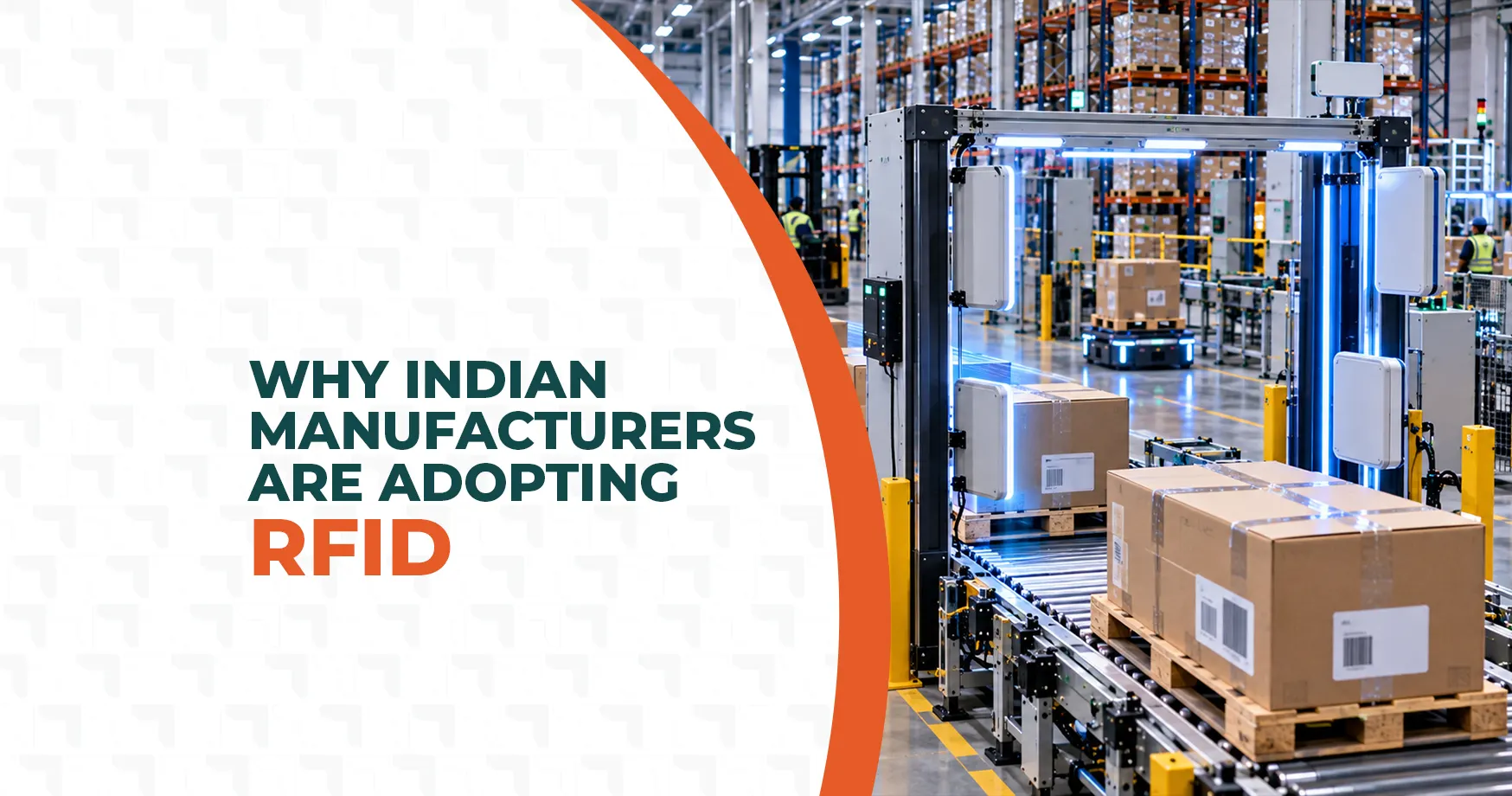
BCI deploys RFID readers and antennas at dock doors, line checkpoints, storage bays, and packaging stations, reading tags automatically without manual handling. Reader placement defines the data quality of every downstream system consuming the feed.
ERP and MES integration
Reader output flows to the WMS, ERP, or MES through Wi Fi, 4G or 5G, or edge compute, generating real-time dashboards, anomaly alerts, and demand forecasts. Without integration, RFID produces data without delivering decisions.
RFID vs barcode

Industry Use Cases of RFID in Indian Manufacturing
Four sectors lead Indian RFID adoption, with use cases shaped by traceability, compliance, and throughput priorities specific to each.
Automotive manufacturing
- JIT delivery tracking and inbound parts confirmation against the build sequence at OEMs.
- Component traceability for OEM compliance and recall investigation under ACMA quality standards.
- WIP visibility across assembly lines, with supply chain coordination across automotive networks running on tag data.
Pharma manufacturing
- Batch traceability and serialisation aligned to CDSCO and GS1 India requirements.
- Regulatory documentation drawing directly from RFID enabled pharmaceutical workflows.
Electronics and FMCG
- Component-level tracking and anti-counterfeiting, supported by traceability across electronics manufacturing under PLI scrutiny.
- Shelf replenishment automation and expiry date tracking for FMCG distribution networks operated by HUL, ITC, and Dabur.
Logistics and warehousing
- Dock door tracking and outbound shipment verification at gates.
- Sortation automation and multi-client 3PL inventory management with SLA reporting.
How to Implement RFID in Indian Manufacturing Operations
A practical RFID rollout in an Indian factory follows a phased pattern that builds operational trust before scaling.
- Pilot on high-value SKUs or assets: First phases target the highest pain tracking gap, for example engine block traceability at an auto plant or finished goods dispatch at an FMCG line.
- Select hardware rated for the environment: Industrial grade tags and RFID readers must withstand heat, chemicals, and electromagnetic interference. Reader placement at dock doors, line checkpoints, and storage bays is defined upfront against the floor map.
- Integrate with existing ERP and WMS: Middleware or APIs connect reader data to SAP, Oracle, or other ERP platforms used by the plant, ensuring real time updates without manual entry.
- Train operators: Frontline staff need structured onboarding, and a successful pilot in one facility builds confidence for enterprise wide rollout.
- Monitor ROI and scale: Track inventory audit time reduction, shrinkage rates, and labour cost savings. Payback periods on high value asset deployments in Indian factories typically fall in a 12 to 18 month range.
Conclusion
RFID is the operational baseline for Indian manufacturers competing on speed, accuracy, and OEM compliance, particularly Tier 1 and Tier 2 suppliers feeding the automotive, pharma, and electronics OEMs that mandate it. BCI supplies and integrates the RFID readers, antennas, and tags that make this work practical on the factory floor, paired with end to end track and trace logic that turns tag reads into compliance grade documentation.