
Rugged Mobile Computer vs Rugged Tablet for Warehouses
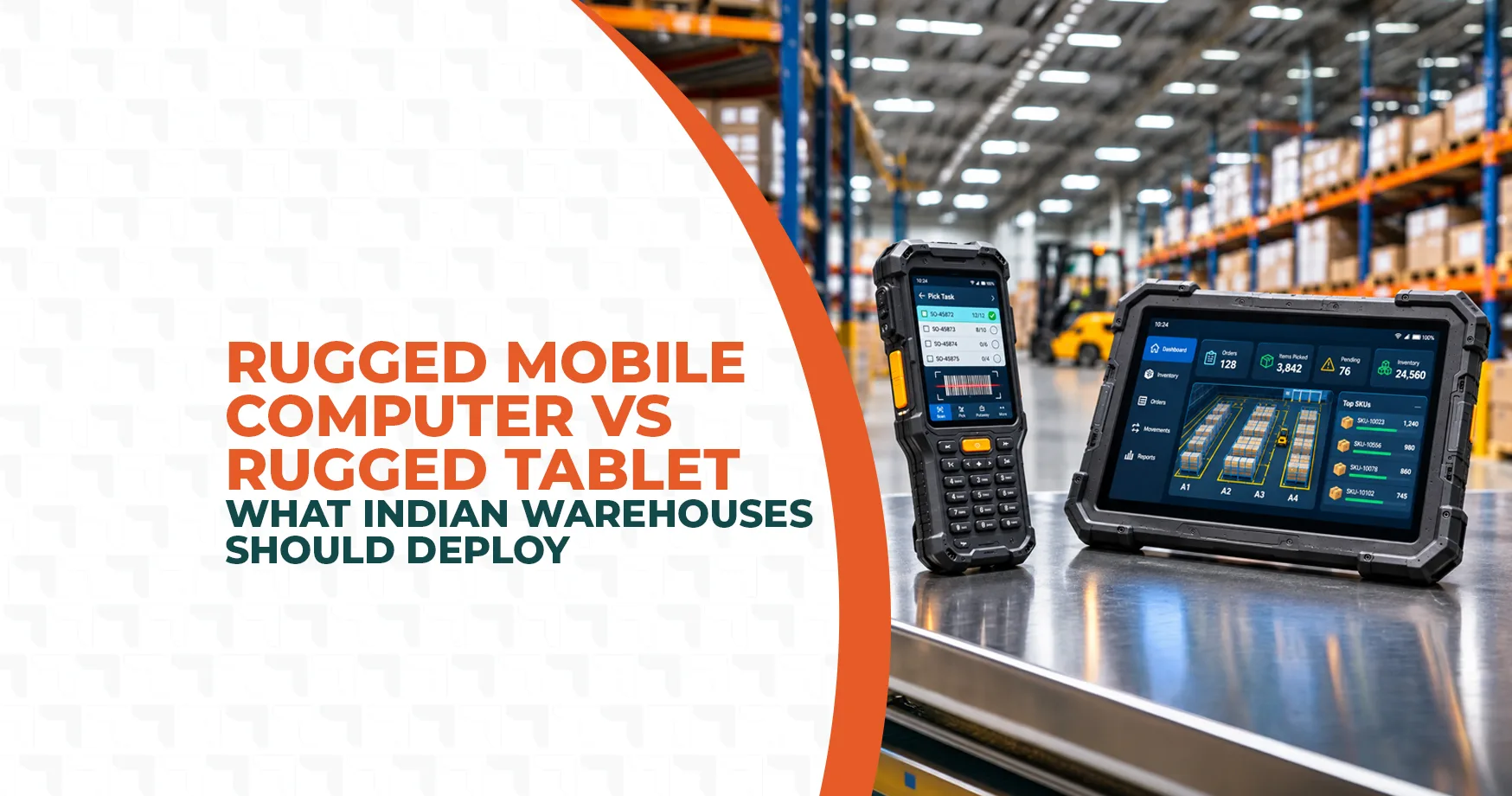
A rugged mobile computer is a compact handheld built for one-handed, high-volume barcode scanning. A rugged tablet has a larger screen, typically 8 to 12 inches, for forms, dashboards and inspection records. Both resist drops, dust and water, and most warehouses deploy handhelds for scanning roles and tablets for screen-heavy ones.
Indian warehouses moving pickers off paper lists and personal phones hit the same question early in a rollout: rugged mobile computer vs rugged tablet. A handheld is built for one-handed scanning on the move. A tablet is built for reading and entering screen-heavy data.
Choose wrong and a tablet slows every pick, or a handheld turns a QC checklist into a squint. Most sites need both. The decision rests on how each device is held and used, what its ratings actually prove, and which warehouse tasks each one speeds up.
What are the key differences between a rugged mobile computer and a rugged tablet?
A rugged mobile computer and a rugged tablet differ mainly in what the worker's hands are doing. The handheld is scan-first: one hand holds it, a thumb fires the scanner, and the other hand moves stock. The tablet is screen-first: it needs two hands or a mount, but it gives workspace for forms and photos.
- Form factor and portability. Rugged handheld mobile computers, often called industrial PDAs, are built to be carried and used one-handed, in slab or pistol-grip designs, by pickers who walk all shift. Tablets typically run 8 to 12 inches and ride on a strap, cart or forklift mount.
- Data entry and use case. Handhelds are fastest where each transaction is a scan and a quantity: picking, counting, put-away and asset checks. Rugged tablets take over where the screen carries the work: checklists, dashboards, yard maps and full enterprise applications.
- Input and connectivity. Handhelds add a keypad and scan trigger to the touchscreen, while tablets rely on a larger touchscreen used with gloves or a stylus. Handhelds can also carry an RFID sled or built-in mobile RFID reader, and read range depends on the tag, the reader and the surroundings. For fixed checkpoints such as dock doors and gates, Bar Code India's DRISTI RFID reader is made in India and supports Ethernet, Serial, Wi-Fi and PoE, with IP65 and IP67 protection.
On paper the two devices differ in everything except durability, where spec sheets quote similar ratings.

Procurement should not take matching durability claims at face value. Under IEC 60529, an IP65 rugged tablet is sealed against water jets, while an IP67 or IP68 model is rated for immersion.
Ask for the IP code, the MIL-STD-810H methods passed, and the drop height and surface for each model. Bar Code India (BCI) supplies rugged handhelds designed to withstand drops of up to 12 ft (3.65 m) onto concrete, with IP65 and IP67 ratings, and rugged tablets that include models available for Zone 0, Zone 1 and Zone 2 hazardous locations.
Definition: MIL-STD-810H is a US Department of Defense test standard (January 2019; Change Notice 1, May 2022) covering laboratory methods for shock and drop, vibration, temperature, humidity, and sand and dust. A device may be tested to only some of them, and the standard is a set of tailored test methods rather than a certification scheme, so a credible datasheet says "tested to" and names the methods.
Which device should Indian warehouses deploy for each task?
Match the device to the task, not the task to the device. The rugged handheld vs tablet test is whether a role moves and scans or stands and reads. Moving, scanning roles want a handheld, because repositioning a two-handed tablet costs seconds on every scan. Reading and recording roles want a tablet.
When to deploy rugged mobile computers
- Picking and put-away. Two trigger pulls confirm location and item while the other hand holds the carton.
- Cycle counting and stock takes. Repetitive scanning across aisles favours a trigger over a touchscreen.
- Receiving and dispatch scanning. Pallet and carton labels are captured at dock speed without setting the device down.
- All-shift walking roles. Compactness and battery life decide whether a warehouse handheld computer lasts the shift.
When to deploy rugged tablets
- Supervisor and shift-lead dashboards. A larger screen shows KPIs, task queues and exceptions at once.
- Inbound quality checks and forms. Checklists, batch details and photos fit on one screen.
- Forklift and vehicle-mount use. A mounted display keeps routes and task lists readable on the move. BCI also supplies purpose-built vehicle-mounted computers for the same job, so compare both.
- Yard, gate and returns processing. Paperwork and the system record sit side by side on screen.
What Indian conditions and budgets change
Indian conditions make ruggedisation the baseline: dust from open docks, heat in uncooled sheds and monsoon humidity wear out consumer phones and tablets fast. Cost shapes the mix: handhelds are bought per worker, while tablets are bought per supervisor or station. Both matter more as WMS automation in Indian warehousing spreads, because e-commerce, 3PL and quick-commerce operations confirm more tasks by scan.
For IT, each task is defined less by the device than by the data it captures and the WMS record it updates.

Every task ends in the same WMS. BCI's handhelds and tablets both integrate with its Warehouse Management System, so a mixed fleet does not split the data. The WMS then posts confirmed receipts and dispatches to the ERP, which stays the system of record. For IT, the choice is screen, input and app support, not a second integration project.
Pack stations are the exception, where neither device is the right buy. A packer at a fixed bench already has a PC running the packing screen, so industrial handheld barcode scanners feed it directly, with no WMS client of their own. That station is judged on order accuracy, one of the core warehouse performance KPIs, so the scanner's job is to confirm every item against the order before sealing. Our guide to warehouse pack station accuracy covers verification methods in more detail.
Devices pay off only when every scan lands in a system that acts on it. Federal-Mogul Motorparts, which supplies automotive components to OEMs and aftermarkets, struggled to identify items individually and track material movement, and manual recording left inventory control weak. BCI's Warehouse Management System, with AIDC (automatic identification and data capture) hardware and ERP integrations, automated material handling, helped manage inventory against MRP, and streamlined packing and dispatch.
Rugged handheld vs tablet: how to decide
The rugged mobile computer vs rugged tablet decision turns on what the worker's hands are doing: trigger scans on the move favour handhelds, and work carried on the screen favours tablets. In Indian dust, heat and humidity, sealed devices tested to MIL-STD-810 methods are the baseline for either. Count scanning, screen and bench positions per shift, then ask BCI to price the device mix against it.
BCI supplies rugged handheld mobile computers, rugged tablets and handheld scanners, so its recommendation follows the task list rather than a product line. Its hardware team specifies devices from a workflow assessment that sorts roles into scanning on the move, working from a screen or sitting at a bench. Each shortlisted model is then matched to the site's WMS client and to the dock, cold room or shed it will work in. Talk to Bar Code India's experts to start that assessment.
Share this page

How to detect and fix quality issues before they leave the factory floor
2D barcode scanner upgrade guide for retailers and manufacturers
What Is Supply Chain Control Tower Software? Capabilities, Benefits and How It Works