2D barcode scanner upgrade guide for retailers and manufacturers
A 1D laser scanner cannot decode a 2D barcode. GS1's Ambition 2027 calls for retail point-of-sale (POS) systems to read and process defined GS1-standardised 2D barcodes alongside existing linear barcodes by the end of 2027, so retailers need to assess their current equipment now. Depending on the existing setup, the transition can require software changes, scanner upgrades, or both.
For retailers, the transition affects scanning hardware, POS configuration, data handling and testing. For manufacturers, it can also affect barcode generation, printing, verification and packaging workflows. Planning early gives businesses time to audit existing equipment, test 2D codes and coordinate hardware and software changes before broader adoption.
Why do you need a 2D barcode scanner upgrade now?
GS1 2D barcodes, such as QR Codes powered by GS1 and GS1 DataMatrix, can carry more than the product number (GTIN) found in a traditional EAN or UPC. They can also hold data such as batch, expiry date or serial number, and can connect to web-based product information through GS1 Digital Link.
The transition does not mean that 1D barcodes suddenly become invalid. GS1 expects a gradual migration in which linear and 2D barcodes coexist.
Some businesses still need new scanning hardware, because a traditional 1D laser scanner reads a barcode by analysing reflected light along a single scanned line. It cannot capture the two-dimensional pattern needed to decode a QR Code or GS1 DataMatrix.
A 2D area imager uses a camera-based scan engine to capture an image of the symbol and decode it. Depending on the model and configuration, an imager can read both 1D and 2D barcodes, and can also read codes displayed on digital screens. This makes a 2D imager a potential replacement for a legacy 1D-only scanner wherever the POS needs 2D capability.
However, the scanner is only one part of the upgrade. The POS application and data-processing workflow must also be able to handle the information in the new barcode.
Definition: An area imager is a camera-based barcode scanner that captures a full image of a symbol and uses decoding software to identify the barcode. Unlike a traditional laser scanner, it can decode two-dimensional symbols such as QR Codes and GS1 DataMatrix.
1D laser scanner vs 2D image scanner

How should retailers upgrade POS scanning for 2D barcodes?
Treat the transition as a combined hardware, software and testing exercise, not simply a scanner replacement.
- Audit existing scanning equipment. Inventory your checkout scanners, handheld devices and other POS scanning equipment. Identify which devices are limited to 1D scanning and which already support the required 2D symbologies.
- Replace equipment where necessary. Where scanners cannot decode the required 2D symbols, replace them with suitable 2D area imagers. Prioritise customer-facing POS lanes and other locations where GS1 2D scanning will be required.
- Configure the required symbologies. A 2D-capable scanner still needs correct configuration. Check the manufacturer's options for the required barcode types, data formatting and communication interface.
- Update POS data handling. A GS1 2D barcode can contain more information than a traditional EAN or UPC. GS1's retail implementation guidance identifies Application Identifiers such as 01 for GTIN, 10 for batch or lot, 17 for expiration date and 21 for serial number. The POS application must determine which elements to use and how to process them.
- Test GS1 Digital Link workflows. A GS1 Digital Link connects a product identifier with web-based information and supports structured product data. The scanner captures the encoded information, but the POS or downstream application decides how it is interpreted and used.
- Pilot before wider deployment. Test representative GS1 QR Codes and GS1 DataMatrix symbols across real products, lighting conditions, scanning distances and POS workflows. Confirm that the POS receives and processes the intended identifier correctly before rolling out across all lanes.
Important: Upgrading the scanner alone does not make a POS GS1 2D-ready. The scanner, POS application and surrounding data workflow must work together so that the encoded information is received and processed correctly.
Bar Code India provides barcode scanning technologies for retail and other operational environments. Its barcode technology solutions can be evaluated as part of a wider scanner-upgrade programme, while POS software configuration and business-system integration should be planned with the relevant software provider.
How should manufacturers upgrade printing and packaging for 2D codes?
A retailer cannot scan a 2D barcode reliably if the symbol is poorly generated, incorrectly positioned or hard to decode. Manufacturers should therefore address four areas: barcode selection, artwork, printing and verification.
- Plan the 1D and 2D transition. During migration, many products will carry a linear barcode alongside a GS1-compliant 2D barcode. GS1 expects the linear barcode to remain in use while retail POS systems build 2D capability.
- Select the appropriate 2D symbol and data structure. QR Codes powered by GS1 and GS1 DataMatrix support different use cases. Base the choice on the product, packaging constraints, required data and intended scanning environment.
- Control the printing process. Because 2D symbols hold information in a two-dimensional pattern, print quality, contrast, module definition and quiet zones all affect reliable decoding. Validate printer selection and settings against the actual symbol size, substrate and production process rather than relying on one universal DPI figure.
- Verify printed codes. A 2D symbol can look acceptable to the eye and still decode poorly. ISO/IEC 15415:2024 specifies methods for measuring and grading the print quality of two-dimensional barcode symbols, so verification should be part of your production quality process.
- Validate the encoded data. A visually correct QR Code is not necessarily a correctly structured GS1 barcode. Check the encoded GTIN and any additional data, such as batch, serial or expiry, against the intended GS1 structure.
Bar Code India provides automated labelling and printing technologies that can support production environments introducing new barcode formats. Its automated labelling solutions can be considered alongside the printer, applicator and verification requirements of the packaging line.
Who is responsible for what?

Where to start your 2D barcode scanner upgrade before 2027
With the end-of-2027 goal now just over a year away, start with an audit of your current scanning and printing environment. The aim is not to replace every scanner or printer because 2027 is approaching. It is to find where existing equipment or software cannot support the required GS1 2D workflow, and fix those gaps before they affect operations.
For retailers:
- Identify all 1D-only scanners.
- Check which 2D symbologies existing equipment supports.
- Confirm POS software and data-processing requirements.
- Test GS1 2D symbols at representative checkout locations.
- Replace or configure equipment where required.
- Roll out changes in phases after successful testing.
For manufacturers:
- Identify products and packaging that will use 2D symbols.
- Determine the required GS1 data structure.
- Validate artwork and symbol placement.
- Test printing on the actual packaging material.
- Verify symbol quality during production.
- Coordinate the transition with retail customers and their scanning requirements.
Prepare your business for the 2D barcode transition
The move to GS1 2D barcodes affects more than the checkout scanner. Retailers need to assess scanning hardware, POS software and data handling, while manufacturers need to consider barcode generation, printing, packaging and verification. An equipment and workflow audit gives both sides time to find compatibility gaps, test real-world 2D codes and plan a controlled rollout.
Bar Code India provides barcode, scanning, printing, labelling and verification technologies that can support organisations evaluating their 2D barcode requirements and preparing for the next generation of GS1 barcodes.
Share this page
What Is Supply Chain Control Tower Software? Capabilities, Benefits and How It Works
Warehouse Pack Station Accuracy: Benchmarks, Verification Methods and How to Improve
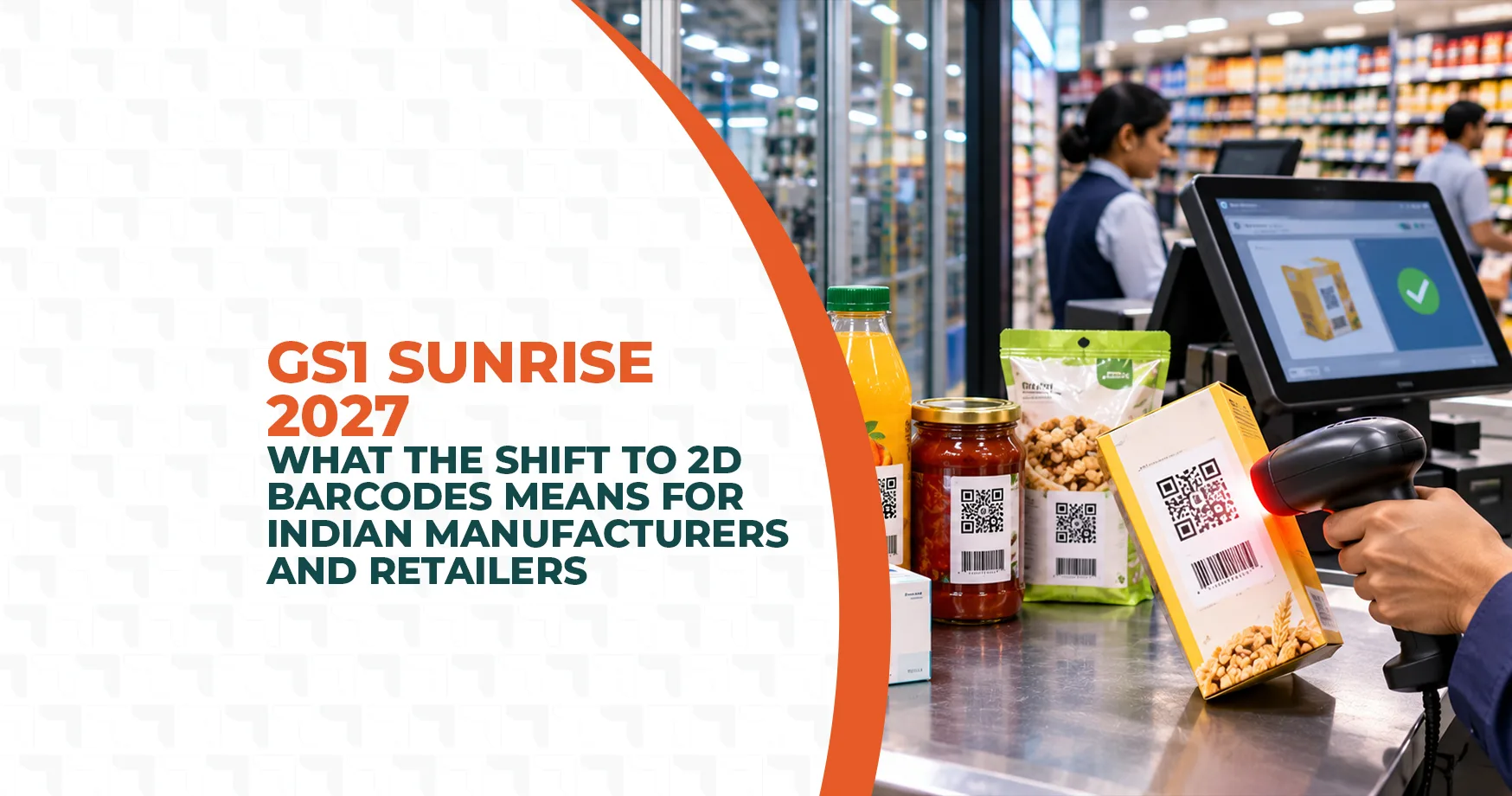
GS1 Sunrise 2027: What the Shift to 2D Barcodes Means for Indian Manufacturers and Retailers