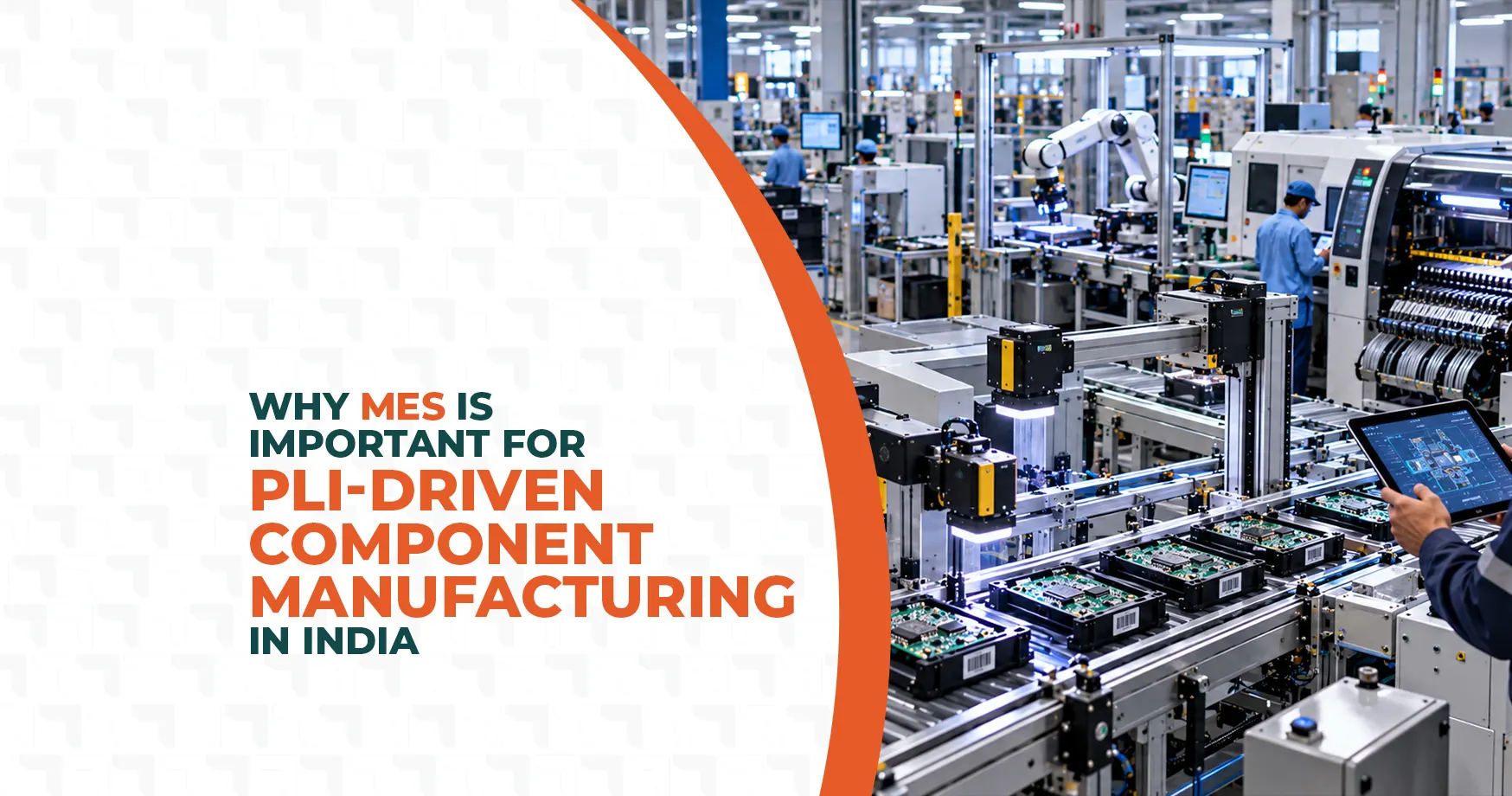


Functions of MES System in the Automotive Manufacturing Industry
MES in automotive manufacturing gives plants precision, efficiency, and compliance across every station, from stamping and body-in-white to final assembly. As vehicles become more complex, with electronics, sensors, and advanced materials, the need for intelligent production management increases. This is where the Manufacturing Execution System (MES) plays a critical role, giving managers real-time control across the automotive supply chain and supporting India's PLI-driven push toward deeper localization in automotive manufacturing.
An MES system bridges the gap between top-floor business systems and shop-floor operations, providing real-time control, traceability, and process optimization essential for modern automotive manufacturing.
1. Production scheduling and real-time monitoring
Production scheduling is the backbone of any automotive manufacturing execution system, coordinating synchronized workflows across assembly lines, component suppliers, and testing units in the auto industry. Manufacturing execution system offers "dynamic scheduling and dispatching" to ensure every work order is executed efficiently, considering machine availability, operator capacity, and material readiness.
Manufacturers gain "real-time visibility into the 4Ms—Man, Machine, Method, and Material" allowing operators to monitor performance, production rates, and downtime instantly. This level of transparency reduces bottlenecks, enhances throughput, and helps maintain production schedules even under high variability or demand fluctuations.
For example, on a high-volume automotive assembly line, MES can calculate OEE at each station and raise andon alerts the moment cycle time drifts from the planned takt, so line supervisors intervene before a single-station slowdown cascades into a full-line stoppage.
2. Batch and Component-Level Traceability
Traceability is paramount in the automotive industry, where each component, from wiring harnesses to ECUs, must meet strict quality and regulatory standards. The MES ensures end-to-end product genealogy, tracking every part, material, and operation throughout manufacturing.
By maintaining detailed batch and component-level records, manufacturers can rapidly isolate affected products in case of defects or recalls. Serialized barcode-based parent-child mapping ensures visibility across assembly stages and packaging. This capability not only ensures compliance but also builds customer trust in the traceability of every product shipped.
BCI's MES for automotive traceability:
BCI's Manufacturing Execution System provides Traceability & Genealogy and Automated machine data capture as core capabilities, building part genealogy from individual components to finished vehicle across the line.
Paired with real-time visibility into material movement, this gives automotive plants the record they need to isolate an affected lot quickly during a targeted recall. BCI's MES integrates with your existing ERP rather than replacing it, so production planning and shop-floor execution stay aligned.
3. Quality Assurance and Root-Cause Analysis
A robust quality control framework is built into the MES, offering real-time validation, system-driven rework management, and root-cause analysis. Automated checks help prevent quality escapes—critical in automotive operations where precision and safety are non-negotiable.
4. ERP and shop-floor integration in MES for automotive plants
In MES for automotive plants, the system acts as the operational backbone between shop-floor execution and enterprise systems such as ERP and PLM. By ensuring "two-way integration" with ERP, shop-floor machines, PLCs, and SCADA systems, MES synchronizes production data, work orders, and resource utilization in real time.
Unlike systems that rely heavily on ERP availability, BCI's MES ensures high resilience with uninterrupted operations even when ERP systems are down, providing ERP-independent uptime and continuous visibility into production.
This integration ensures that planning and execution are always aligned, reducing manual intervention and eliminating data silos.
5. Workflow Optimization and Scheduling Precision
Automotive manufacturing processes, from body assembly to final inspection, must move with finely tuned precision. MES systems in automotive industries leverages alert-based notifications and intelligent workflow rules for production planning and scheduling, ensuring tasks are prioritized appropriately and executed within optimal time windows.
Core functions such as operation tracking, routing adherence, and sequential control maintain operational accuracy while enabling agile responses to production changes.
6. Compliance, Audit Trails, and Regulatory Readiness
With increasing regulatory oversight in automotive manufacturing, MES systems simplifies audit-readiness by maintaining comprehensive electronic records, including full genealogy, digital audit trails, and timestamped operator logs.
This automated compliance layer ensures traceability throughout production, validates workflows, and provides ready-to-audit evidence, helping manufacturers meet mandates and international quality standards efficiently.
Case Study: MES Implementation in Automotive Electronics Manufacturing
BCI’s MES was deployed for a leading automotive electronics manufacturer, specializing in Surface Mount Technology (SMT) and PCB assembly lines. The system achieved comprehensive traceability and advanced process control across the entire production flow.
This deployment reduced manual interventions, eliminated quality lapses, and enabled real-time process validation, resulting in faster production cycles and higher yields. The automotive manufacturer now benefits from data-driven genealogy mapping that supports immediate root-cause diagnostics and efficient recall handling—critical advantages in high-volume automotive component production.
Read Detailed Case Study: https://www.barcodeindia.com/case-study/MES-%20EMS
7. Data Analytics and Continuous Improvement
MES provides real-time dashboards and comprehensive data analytics, giving management actionable insights into performance metrics such as machine utilization, defect rates, and production lead times. These analytics help identify weaknesses, optimize workflows, and achieve lean manufacturing goals.
By continuously learning from operational data, manufacturers can adapt more quickly to production variables, project accurate timelines, and reduce overall manufacturing costs.
BCI’s MES: Driving the Automotive Digital Transformation
BCI’s MES positions automotive manufacturers at the forefront of this transformation with:
- Scalable and modular architecture for diverse production setups
- Integrated quality control and rework management to maintain zero-defect goals
- End-to-end traceability and genealogy mapping across all product levels
- ERP-independent operation for uninterrupted uptime
By uniting advanced traceability, analytics, and workflow automation, BCI’s MES empowers automotive manufacturers to achieve consistent quality, improved efficiency, and regulatory readiness—while accelerating their journey toward a truly connected smart factory.
In conclusion,
the MES system in the automotive manufacturing industry serves as the digital backbone that connects every moving part of production—from machines and operators to materials and management. With BCI’s MES, manufacturers can turn real-time data into strategic action, ensuring operational excellence that drives profitability, compliance, and customer satisfaction.