
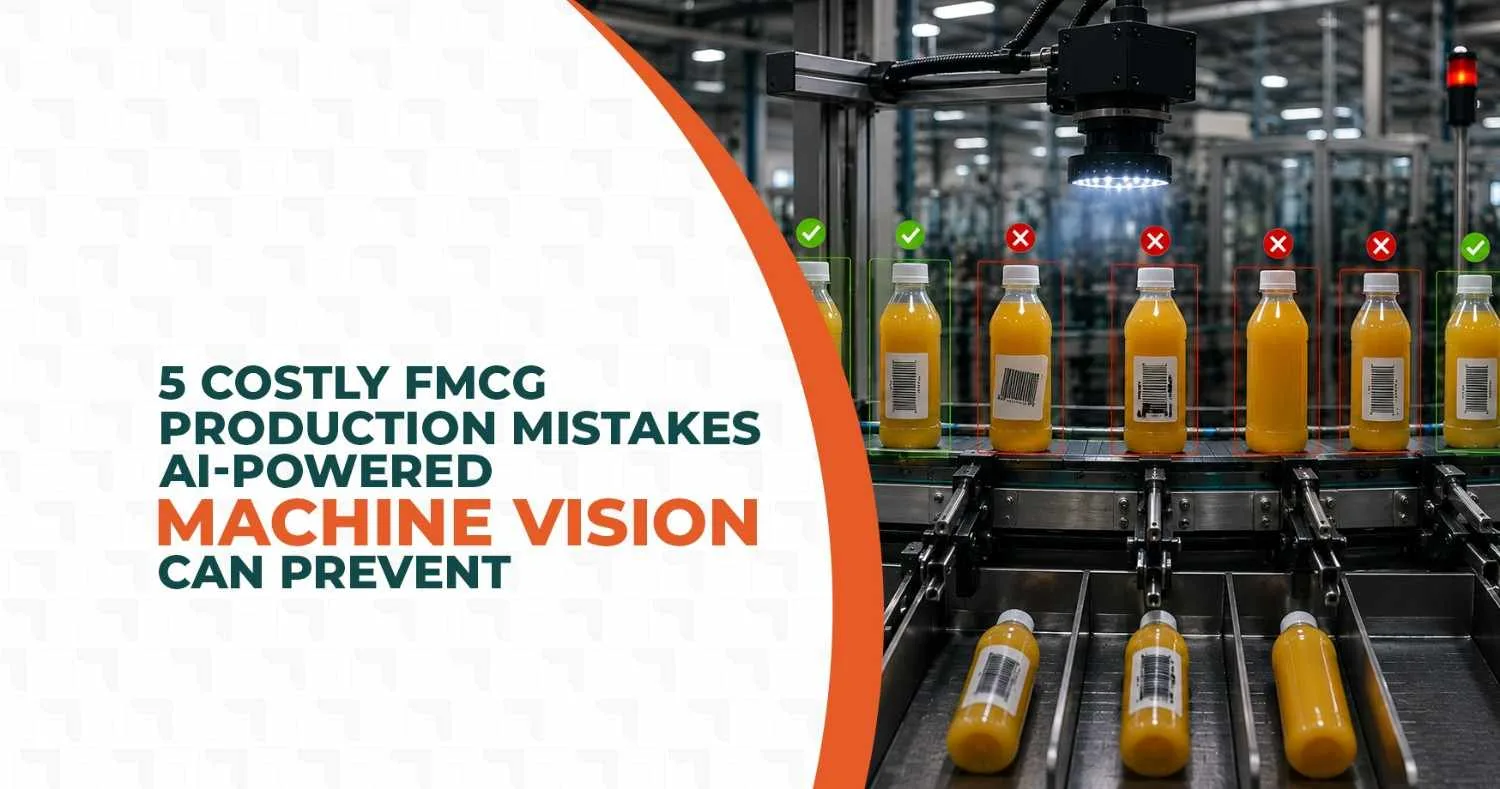
5 Costly FMCG Production Mistakes AI-Powered Machine Vision Can Prevent
A single packaging error on a high-volume FMCG line can snowball fast. A missing expiry date on a batch of 50,000 tetra packs, a barcode that won't scan on a shrink-sleeved PET bottle at retail checkout, a mis-sealed sachet that reaches a consumer; these are not hypothetical scenarios. They are recurring, costly realities for manufacturers who rely on manual inspection or legacy quality systems that simply cannot keep pace with modern production demands.
Consider the scale of the problem: according to industry estimates, packaging defects and labelling errors account for over 30% of FMCG product recalls globally, and a single mid-scale recall event can cost a manufacturer anywhere between ₹2 crore and ₹50 crore when you factor in logistics, regulatory engagement, and brand remediation. Consumer expectations have never been higher, and FSSAI labelling mandates have never been stricter.
This is where machine vision in FMCG manufacturing is changing the game. Once confined to automotive or semiconductor plants, AI-powered visual inspection is now firmly embedded in food and beverage factories, dairy operations, flexible packaging lines, and personal care facilities across India. It doesn't blink, doesn't fatigue, and doesn't miss.
Here are five of the most expensive production mistakes FMCG manufacturers face, and how machine vision eliminates them before they reach the shelf.
1. Packaging Defects That Slip Past the Human Eye
The Challenge
On a line producing 300 units per minute, a human inspector physically cannot evaluate every pack. The failure modes are wide-ranging: unsealed sachets in a spice or nutrition powder line, misaligned shrink sleeves on PET bottles, missing caps on cooking oil containers, delaminating labels on tetra packs, or blister packs with unfilled cavities in the OTC healthcare segment. These defects routinely make it through to dispatch, triggering customer complaints, returns, and reputational damage. In categories like infant nutrition, dairy, or pharmaceuticals, a compromised seal is not just a quality failure; it is a safety incident.
How Machine Vision Solves It
Packaging inspection automation systems use high-resolution cameras combined with AI-trained algorithms to inspect every single unit, in real time, at line speed. The system compares each product against a defined "golden sample," flagging and rejecting any unit that deviates: an off-centre label on a flexible pouch, a shrink sleeve that hasn't fully conformed to a beverage bottle, an incorrectly seated cap on a dairy container, or an incompletely heat-sealed snack food sachet.
Unlike a human inspector who fatigues after a few hours, a machine vision system maintains 100% inspection consistency across an entire production shift and logs every result with image capture for audit and traceability purposes.
Business Impact
Brands operating in the biscuits, beverages, and personal care segments report significant reductions in customer complaints and returns once automated visual inspection is deployed on primary and secondary packaging lines. The ROI case is straightforward: catching a defective batch of 10,000 units before dispatching costs a fraction of managing a market withdrawal.
2. Barcode and QR Code Failures That Disrupt the Supply Chain
The Challenge
Modern FMCG supply chains run on barcode data, and the failure rate is higher than most operations teams realise. Research from GS1 indicates that barcode scan failure rates in FMCG can reach 10–15% in poorly managed packaging environments, causing delays at distribution centres, checkout failures at retail POS, and gaps in traceability records. The problem is especially acute in formats where print quality is variable: flexible pouches that wrinkle post-fill, shrink sleeves that distort the code of geometry, or PET bottles where label adhesion causes surface irregularities. For brands supplying modern trade or e-commerce fulfilment centres, a non-compliant barcode can trigger retailer chargebacks or delisting penalties.
How Machine Vision Solves It
Barcode inspection systems verify every code on the line, checking not just that a barcode is present, but that it is readable, correctly graded, and contains the right data. These systems can validate 1D barcodes, 2D QR codes, and Data Matrix codes against packaging specifications, rejecting any unit that does not meet the defined read-quality threshold before it leaves the line.
For brands tracking product traceability through the supply chain, this layer of verification ensures that every unit in a shipment carries a scannable, accurate code, protecting both the brand and the retailer relationship.
Business Impact
Reduced downstream scanning failures, fewer returns from distribution partners, and improved retail compliance scores. For manufacturers supplying modern trade, this can directly protect listing agreements and reduce costly chargebacks.
3. Expiry Date and Batch Code Errors That Trigger Recalls
The Challenge
Incorrect, missing, or illegible expiry dates and batch codes are among the leading causes of FMCG product recall worldwide, and the problem is more common than the industry likes to admit. A jet printer that runs low on ink mid-shift, a coding unit that skips a cycle on a high-speed dairy line, a date format printed incorrectly on a tetra pack carton, or a batch code so faint it's unreadable on a transparent flexible sachet, any of these sends thousands of non-compliant units into the trade. In India, FSSAI regulations mandate clear, legible date marking on all packaged foods. Internationally, consequences range from import rejection to significant regulatory penalties. Studies suggest that date-coding errors alone account for nearly 20% of all food and beverage recall events in Asia-Pacific markets.
How Machine Vision Solves It
OCR/OCV inspection addresses this precisely. OCR reads the printed characters on each pack, expiry dates, batch codes, MRP, and manufacturing locations. OCV goes further, verifying that what is printed matches what should be printed, character by character. If the ink skips, fades, or prints incorrectly, the system flags and rejects the unit instantly.
These systems operate inline, at full production speed, without slowing the line, making 100% date verification practical even on high-throughput operations.
Business Impact
Eliminating date-coding errors is one of the fastest-payback applications of machine vision in FMCG. A single recall event, the logistics, the regulatory engagement, the consumer communication, and the brand damage can cost a mid-sized manufacturer for several crores. Inline OCR/OCV inspection makes that scenario avoidable.
4. Inconsistent Quality at High Production Speeds
The Challenge
Speed and quality are historically in tension on the packaging line. A beverage bottling operation running at 600 bottles per minute, a snack food line filling and sealing 800 sachets per minute, or a dairy operation capping 400 cups per minute, none of these can accommodate the throughput loss that traditional manual inspection demands. The forced choice becomes slow for the line to inspect properly or run at target speed and accept a higher defect rate. In high-volume FMCG, neither is commercially viable.
How Machine Vision Solves It
Modern AI-powered visual inspection systems are purpose-built for these environments. High-frame-rate cameras and deep learning-trained models inspect products at full line speed without a throughput penalty, and detection sensitivity is tunable to the specific product format and defect type, reducing false rejects (which waste good product) and missed defects simultaneously.
Production line quality control shifts from an end-of-line checkpoint to a continuous, embedded process. Inspection data feeds real-time dashboards that help QA teams spot patterns, intervene proactively, and address root causes rather than discovering problems after thousands of units have already been packed and palletised.
Business Impact
Manufacturers in the dairy, snacks, and home care categories have reported measurable improvements after deploying machine vision because fewer stops, fewer manual checks, and faster defect identification keep the line running efficiently.
5. Product Waste and Brand Damage from Late-Stage Defect Detection
The Challenge
The later a defect is detected, the more expensive it becomes, in wasted material, rework labour, and line downtime. A fill-level deviation caught at the filling station on a beverage bottling line costs almost nothing to correct. The same defect caught at the palletiser means an entire production batch may need to be manually sorted. On a flexible packaging line for spices or instant noodles, a seal integrity failure identified post-cartoning can mean writing off not just the product, but the packaging and labour invested in the entire downstream process.
How Machine Vision Solves It
Defect detection in FMCG using machine vision operates at the earliest possible stage, inline, before product advances further down the line. Surface defects, foreign objects, fill-level deviations, colour inconsistencies, and structural anomalies are flagged immediately. Automated rejection mechanisms remove non-conforming units without stopping the line, while the system logs every rejection with image capture for audit purposes.
This early-detection capability directly reduces waste: fewer compliant units are caught up in batch rejections, and root causes can be identified faster because each defect is documented in real time.
Business Impact
Smart manufacturing in FMCG is not just about automation; it is about building a quality culture backed by data. Machine vision systems generate rich inspection data that support root cause analysis, supplier quality management, and continuous improvement initiatives. For brand owners, the biggest benefit may be intangible but significant: consumer trust in products that consistently arrive intact, correctly labelled, and safe.
Why FMCG Manufacturers Choose Bar Code India
Bar Code India (BCI) brings something that generic automation vendors typically cannot: deep, applied experience across the specific packaging formats, line speeds, and compliance requirements that define FMCG production in India. That means a BCI deployment is calibrated for your operating reality, whether you're running PET bottle lines at 600 units per minute, inspecting shrink sleeves on tetra packs, verifying date codes on flexible sachets, or grading barcodes on blister packs.
BCI's machine vision solutions cover the full inspection stack: multi-dimensional reading (1D, 2D, and 3D vision systems), high-speed cameras and processors rated for demanding line environments, OCR/OCV date and batch code verification, barcode and QR code grading, label and packaging defect detection, fill-level monitoring, and surface inspection. Crucially, the hardware is configurable, not a fixed template dropped onto your line.
Where BCI stands apart is in integration and deployment speed. Systems are designed to work with your existing line of architecture and enterprise systems, minimising downtime during commissioning. Real-time monitoring dashboards give QA managers, plant heads, and operations teams a live view of line performance, defect trends, and rejection rates, without requiring a separate data team to interpret the output.
BCI also supports the traceability and compliance reporting requirements that organised retail and export customers increasingly demand — making machine vision not just a quality tool, but a business enablement platform.
The Bottom Line: Quality Control Is Now a Competitive Advantage
Machine vision in FMCG is no longer a premium investment reserved for multinationals. It is the fastest-scaling quality control upgrade available to any manufacturer running a high-volume packaging operation, and the ROI case closes quickly once your account for the cost of defects reaching trade, recalls avoided, and retail compliance penalties eliminated.
The five risks outlined above exist on every manual or semi-automated line. AI-powered machine vision addresses each one at the source, inline, at full production speed, with documented evidence for compliance and continuous improvement.
The manufacturers who deploy it now will be the ones setting the quality benchmark their competitors are chasing in three years.