
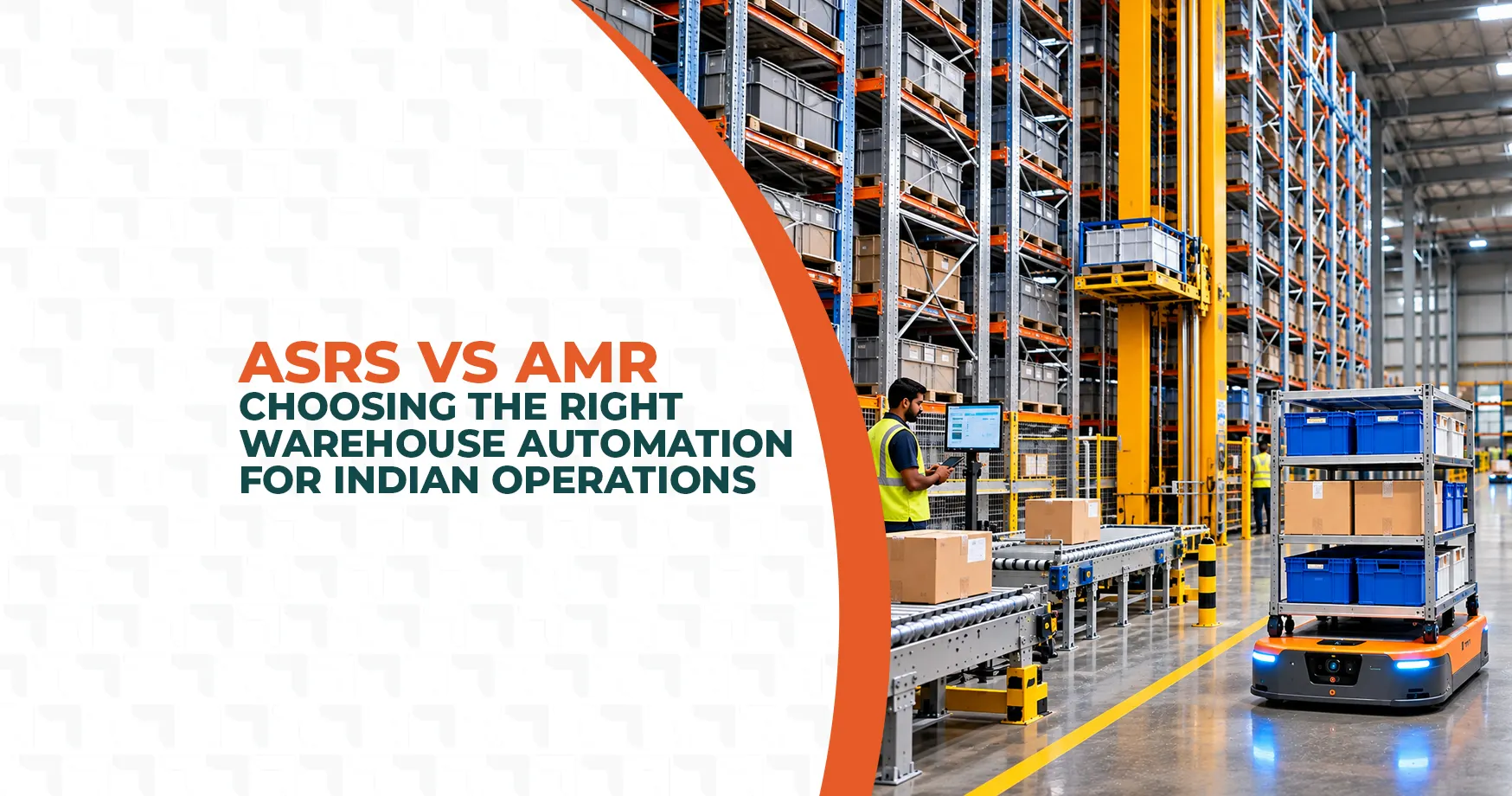
ASRS vs AMR: Choosing the Right Warehouse Automation for Indian Operations
A warehouse that installs an ASRS to fix slow picking can end up with expensive racking it cannot fill. In a leased shed with standard ceilings and a SKU mix that shifts every season, the density that justified the investment may never arrive.
More Indian operations now face the ASRS vs AMR decision as e-commerce, organised retail and 3PL volumes grow. The two systems solve different problems. An ASRS (automated storage and retrieval system) is fixed infrastructure for dense storage. An AMR (autonomous mobile robot) is a flexible robot that moves goods across an open floor. This guide explains how each works, how they compare on space, capital and scalability, and which one suits Indian buildings and budgets.
The short answer: an ASRS stores and retrieves stock inside fixed racking using cranes, shuttles or mini-loads, so it suits dense, stable inventory. An AMR navigates open floors on its own to move goods, so it suits changing layouts and phased investment. Many Indian warehouses end up using both under one WMS.
How do ASRS and AMR systems work?
An ASRS moves stock within a fixed structure. An AMR moves it across an open floor. Where the motion happens decides building fit, capital cost and how the system scales. Software above both decides what moves, and when.
ASRS (automated storage and retrieval system)
An ASRS uses cranes, shuttles or mini-load machines running on set paths through rigid racking. They store and retrieve pallets, cases or totes without manual handling. Most installations work goods-to-person: stock is brought to a stationary operator instead of the operator walking to the stock. Because the system is engineered around one building and one inventory profile, it turns vertical height into storage, but it is costly to change after commissioning.
AMR (autonomous mobile robot)
An AMR builds a map of the floor and uses onboard sensors to plan its own route. If a person, pallet or blocked aisle gets in the way, it re-routes instead of stopping. It needs no guide wires, magnetic tape or reflectors, so it can run inside an existing building. Safety requirements for driverless industrial trucks, AMRs included, are set out in ISO 3691-4:2020.
The contrast with an AGV (automated guided vehicle) is useful here. An AGV follows fixed paths marked by guides or markers. An AMR navigates dynamically, so it suits floors where layout and traffic change.
The WMS that ties them together
Neither system works well on its own. A warehouse management system (WMS) decides which task goes where. BCI's WMS sends storage, retrieval and transport tasks to the ASRS and the AMR fleet based on live inventory and order priority. It tracks each completed task, updates stock records in real time and manages exceptions when an automated task cannot be completed. It also exchanges data with your ERP.
AI agents add a further layer. BCI NAVI, for example, works alongside the WMS to flag bottlenecks and material-flow problems so that supervisors can act on them. The WMS dispatches, and the AI agent supports decisions.
What are the key differences between ASRS and AMR?
Deployment cost sets the capital committed before the first pick. Scalability sets what each later increment of capacity costs.

The trade-off is capital against change. An ASRS pays back at scale when inventory is stable and uniform. AMRs are bought in increments, so the first robots prove the case before more are ordered.
Using ASRS and AMR together
Many sites combine them. The ASRS holds dense storage, and AMRs carry retrieved totes to pick and pack stations. The handover happens at the ASRS port, so port throughput becomes the design constraint: a port that cannot keep pace leaves robots queuing. Because the pack bench becomes the last check on a mis-pick, baseline your order picking accuracy and other warehouse KPIs before the robots arrive.
Fix the inventory record first
Both systems inherit every error in the inventory record. A robot fetches exactly the tote the system says holds the SKU. Automating on unverified location data turns each putaway error into a repeatable wrong retrieval.
Verify at receiving. Scan each inbound carton or pallet against the ASN, or capture it with RFID at the dock door, before putaway. BCI's DRISTI IoT RFID reader is built for this kind of automatic capture. Fix labels, location discipline and the stock record before go-live, not after the first week of mis-picks.
Which warehouse automation should Indian operations choose?
Three factors decide it: what the building allows, how stable the inventory is, and how much capital is available up front. Height, uniform stock and long-term capital favour ASRS. An existing building, variable demand and a small first budget favour AMRs. When the factors split, the answer is often both, phased over time.
When ASRS makes sense
- High ceilings and a need for density. An ASRS turns clear height into storage positions, so the same footprint holds far more stock.
- High-volume, uniform inventory. Consistent case and tote sizes let a fixed machine repeat one retrieval cycle without exceptions.
- Goods-to-person picking at volume. Picking concentrates at a few stations, so pick rate depends on the machine rather than on walking distance.
- Temperature-controlled zones. An ASRS reduces the time people spend in cold or harsh areas.
- Rule-driven stock rotation. An ASRS working with the WMS can follow FIFO, FEFO and other storage and retrieval rules, which matters in pharma and food.
When AMRs make sense
- A fast, lower-cost start. AMRs need no rack rebuild or civil work, so you can begin with a small fleet.
- Changing layouts or standard ceilings. A new floor plan means re-mapping the fleet, not rebuilding it, and no extra clear height is needed.
- Odd-sized goods or seasonal swings. Robots can be added ahead of a festive-season peak, and dynamic routing copes with mixed carton sizes.
- Robots working alongside people. AMRs take the transport legs while pickers stay in their zones, so labour shifts from walking to picking.
- Phased automation. An AMR fleet can run alongside existing manual operations, with the WMS managing both, before you expand further.
Each priority also carries a site check that can overturn it, such as a floor load rating too low for high-bay racking.
 Why AMR-first suits many Indian sites
Leased buildings and capital sensitivity tilt the Indian default towards AMR-first, with ASRS where density justifies the capex. Grade A space is growing: JLL reports its share of 3PL warehouse leasing rose from 50% in 2021 to 57% in 2025. That still leaves a large share of operations in older or standard-height space, where an engineered structure pays back only if the operation stays for years.
ASRS earns its place in purpose-built distribution centres, cold chain, pharma, 3PL hubs and high-throughput retail and e-commerce sites with stable inventory. For retailers picking single units, item-level RFID (with readers such as DRISTI) is one route to the accuracy that automation depends on.
Sequence matters: a real example
The order of investment matters as much as the choice. A consumer durables company moving 13,000 to 70,000 cases a day through 20,000 storage locations faced slow picking, poor stock visibility and loading delays of up to 20 minutes per transaction while inventory synced between SAP and its portal app. BCI deployed a barcode-based warehouse automation solution integrated with the company's ERP, and the site reached 99% inventory visibility. Any robot added later would act on that verified record, which is why a WMS-managed inventory record usually comes first. Read more about WMS automation in Indian warehousing.
ASRS vs AMR for Indian warehouses: the practical sequence
ASRS vs AMR is a choice between a fixed storage engine and a flexible transport layer. The building, the inventory profile and the available capital decide it. For many Indian operations the sound sequence is verified receiving data first, AMRs next, and an ASRS where density justifies the capex, often with both under one WMS.
Start by profiling your site on clear height, SKU uniformity, peak volume and remaining lease term. Then match that profile against the ASRS and AMR systems that Bar Code India integrates with its WMS. Talk to our experts to shortlist the right ASRS, AMR or combined setup for your site.