
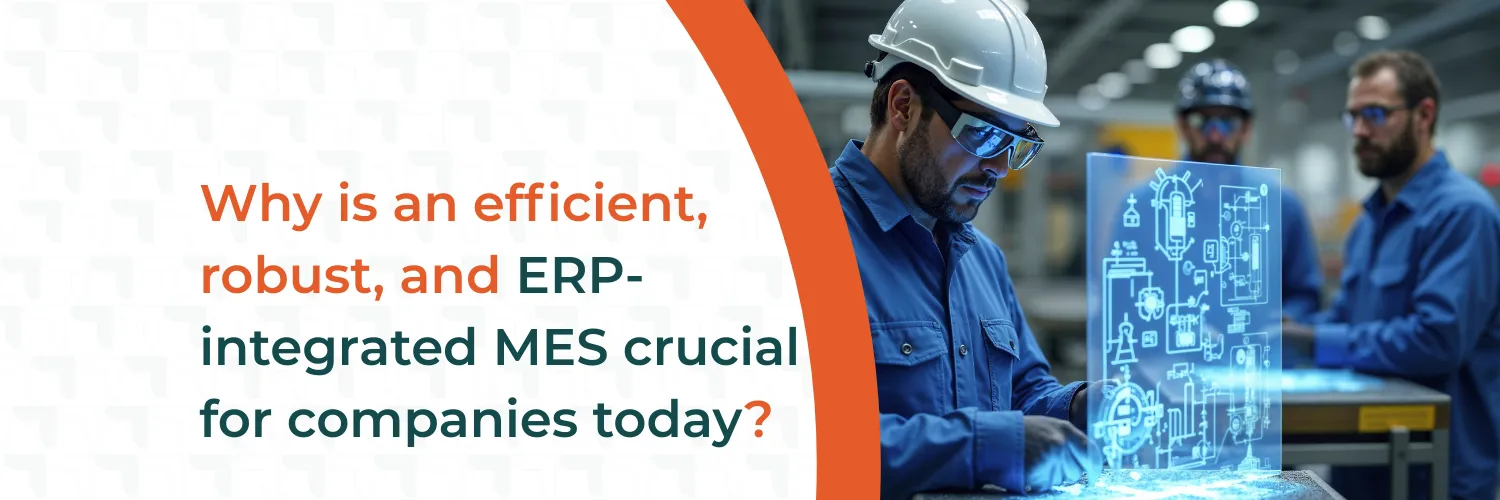
Why is an efficient, robust ERP-integrated MES crucial for companies today?
Businesses are open to implementing solutions that can improve efficiency, reduce costs, and maintain a competitive edge in the market. One of the critical tools aiding businesses in achieving these goals is an efficient, robust, and ERP-integrated Manufacturing Execution System (MES). Let's start with the basics. An MES is a software system that operates at the intersection of production and business operations. It bridges the shop floor, where manufacturing occurs, and the enterprise-level systems that oversee broader business functions. An efficient MES provides real-time visibility into production operations. This means that businesses can closely monitor and manage every aspect of their manufacturing processes as they unfold. This visibility is a game-changer, allowing companies to identify and address bottlenecks, reduce downtime, improve quality control, and optimize equipment efficiency.
Robust MES solutions help streamline production processes by integrating with the ERP and shop-floor systems. They offer a centralized platform for managing manufacturing operations, including scheduling production orders, tracking inventory levels, and ensuring quality control. This consolidation of information leads to smoother operations and greater control over the manufacturing process. About 70 percent of businesses already use hardware and software to connect essential elements of their organizational processes. The integration of MES with ERP systems is another critical aspect. While MES focuses on the intricacies of production, ERP systems handle broader business functions like finance, inventory management, and sales. When these systems work seamlessly together, businesses can make well-informed decisions, allocate resources effectively, and plan strategically. This integration facilitates data synchronization, ensuring that all parts of the organization access the most up-to-date information.
What is a MES?
Manufacturing Execution Systems monitor what's happening during production, helping managers make quick decisions and improving how things are made. MES software handles many tasks, such as planning when things should be made, ensuring machines and materials are used correctly, and checking how well everything is going. This makes factories work better and faster.
What is an ERP?
An Enterprise Resource Planning (ERP) system is a powerful software tool organizations use to manage and integrate various aspects of their business processes. It centralizes data and functions related to finance, human resources, inventory, customer relations, and more into a single platform. ERP systems enhance decision-making, streamline operations, and improve overall efficiency. This enables businesses to optimize resource allocation, reduce costs, and respond more effectively to the ever-changing demands of the modern business environment.
How Does an MES Differs from an ERP?
Manufacturing Execution Systems (MES) and Enterprise Resource Planning (ERP) systems are both critical software solutions used by organizations, but they serve distinct purposes and operate at different levels within a business. Here's how they differ:
Scope and Functionality
MES: MES is primarily focused on managing and optimizing manufacturing operations. It deals with the real-time aspects of production, such as monitoring machine performance, tracking work orders, ensuring quality control, and managing inventory on the shop floor. MES provides detailed insights into the manufacturing process and is crucial for achieving efficient and precise production.
ERP: ERP, on the other hand, is a comprehensive system that integrates various business processes across an entire organization. It encompasses functions beyond manufacturing, such as finance, human resources, procurement, sales, and customer relationship management. ERP's primary role is facilitating data flow and information sharing among different departments, enabling efficient resource planning, decision-making, and reporting across the enterprise.
Timeframe and Focus
MES: MES operates in real-time, addressing immediate concerns on the shop floor. It is highly responsive to events, ensuring production processes run smoothly and efficiently.
ERP: ERP takes a broader, long-term perspective. It optimizes business processes by providing historical data, trends, and insights. ERP is essential for strategic planning and resource allocation.
Users and Objectives
MES: MES is primarily used by production managers, supervisors, and operators who need minute-by-minute data to make real-time decisions. Its goal is to improve production efficiency, reduce downtime, and maintain product quality.
ERP: ERP is used by various departments, including finance, HR, sales, and management. Its objectives are to facilitate cross-functional collaboration, provide a unified view of business data, and support strategic decision-making at the enterprise level.
Integration
MES: MES software can be integrated with ERP systems to exchange critical data. This integration ensures that production data seamlessly flows into the broader organizational context provided by the ERP.
ERP: ERP systems are designed to be integrated with various specialized systems, including MES, to create a cohesive ecosystem within the organization. This integration allows data to flow seamlessly between different functional areas.
The Benefits of Integrating MES with ERP
Enhanced Visibility and Control:
Integration offers a unified view of data, allowing organizations to monitor production processes in real-time while having insight into the entire business operation. This visibility enables proactive decision-making and better control over production.
Improved Efficiency and Productivity:
The MES-ERP synergy streamlines data flow and automates manual processes, reducing the risk of errors and duplication of effort. This, in turn, increases production efficiency and overall productivity.
Accurate Resource Allocation:
Integrated systems provide comprehensive data on resource utilization, allowing organizations to allocate materials, labour, and equipment optimally. This ensures that resources are used efficiently, reducing waste and costs.
Real-time Data Exchange:
The integration enables seamless data exchange between MES and ERP. When changes occur on the shop floor, such as updated production schedules or inventory levels, this information is instantly reflected in the ERP system and vice versa. This real-time synchronization ensures that all stakeholders work with the most up-to-date information.
Improved Quality Control:
MES software monitors and controls critical quality parameters during production. Integrated with ERP, this data can be correlated with quality assurance processes, enabling quick identification and rectification of quality issues.
Better Compliance and Reporting:
MES captures detailed manufacturing data required for compliance with industry regulations and standards. Integration with ERP simplifies compliance reporting by consolidating this data and automating the generation of compliance reports.
Enhanced Customer Responsiveness:
Real-time data from MES allows organizations to respond swiftly to customer orders or market demand changes. By integrating with ERP, customer service teams can access accurate information to react quickly and meet customer expectations.
Streamlined Financial Management:
Integrated systems facilitate the flow of financial data, such as cost of goods sold (COGS) and inventory valuation, from the shop floor to financial departments. This streamlining of financial processes ensures accurate accounting and financial reporting.
Better Decision-Making:
Access to real-time data and comprehensive insights empowers organizations to make informed decisions. Integration gives executives and managers a holistic view of operations, facilitating strategic planning and resource allocation.
Understanding the ISA-95 Framework for MES and ERP Integration
The ISA-95 framework is the global standard for harmonizing enterprise, warehouse management systems, and other control systems. According to this framework, the integration of the Manufacturing Execution System (MES) occurs at Level 3, connecting with the Warehouse Management System (WMS). Furthermore, it interacts with the Enterprise Resource Planning (ERP) system at Level 4 and interfaces with the Programmable Logic Controllers (PLC) and Supervisory Control and Data Acquisition (SCADA) systems at Level 2. The primary aim behind developing the ISA-95 framework was to mitigate risks, cut costs, and minimize errors in the integration process. It ultimately facilitates a secure, cost-efficient, and reliable exchange of information. The principal objective of an ISA-95 compliant MES and WMS solution is to effectively oversee, supervise, and coordinate real-time physical processes, commencing from inventory reception, proceeding through the transformation of raw materials into finished products, and culminating in the delivery to the end customer. This system manages the execution of work orders in tandem with production scheduling and enterprise resource planning (ERP). It also furnishes valuable feedback on process performance and ensures the traceability and genealogy of products, all while seamlessly integrating with the process history for comprehensive process management.
Things to Consider When Integrating ERP with MES
- Business Objectives and Alignment: Start by clearly defining your organization's goals and objectives for integration. Understand what specific outcomes you aim to achieve, such as improved production efficiency, better resource allocation, real-time data access, or enhanced reporting capabilities. Ensure that these objectives align with your broader business strategy.
- Compatibility and Standardization: Ensure that your ERP and MES software are compatible regarding technology and data formats. Standardization of data structures and communication protocols is crucial for smooth integration. Verify that both systems support industry-standard interfaces and data exchange formats.
- Data Mapping and Process Harmonization: Analyze your existing processes within both ERP and MES software. Identify where data needs to flow between them and define how this data will be mapped and synchronized. Streamlining processes to align with best practices is often required during integration.
- Real-time Data Exchange: Determine the frequency and nature of data exchange between ERP and MES. Real-time data sharing is essential for achieving timely decision-making. Consider the volume of data, transaction speeds, and potential network constraints when planning for real-time integration.
- Security and Data Privacy: Data security is paramount. Ensure that sensitive information remains protected throughout the integration process. Implement encryption, authentication, and access controls to safeguard data from unauthorized access or breaches.
- Scalability and Flexibility: Assess the scalability of your integrated system. Consider future growth and expansion plans and ensure the integrated solution adapts to evolving business needs. Flexibility is crucial in accommodating changes in production processes or technology upgrades.
- Change Management: Employee training and change management are crucial to integration success. Ensure your workforce is adequately trained to use the integrated system and understands how it impacts their daily tasks.
- Vendor Support and Expertise: Engage with vendors who have experience in ERP-MES integration. Vendor support and expertise are invaluable during the planning, implementation, and post-implementation phases. They can help address technical challenges and ensure the integration aligns with industry best practices.
- Testing and Validation: Rigorous testing is essential to identify and rectify any integration issues before going live. Testing should encompass data accuracy, process flows, user acceptance, and disaster recovery scenarios.
- Monitoring and Maintenance: Post-integration, establish ongoing monitoring and maintenance processes. Regularly review system performance, data integrity, and security measures. Proactive maintenance ensures that the integrated ERP-MES system continues to deliver value over time.
When integrating Manufacturing Execution Systems (MES) with your existing Enterprise Resource Planning (ERP), BCI's MES stands out as the best choice. It seamlessly connects with your ERP, ensuring compatibility and smooth data exchange. With the integration of our services, you can experience improved visibility, efficiency, and scalability while receiving robust support from our experienced team at BCI. By choosing our MES, you can streamline your operations with warehouse automation and set your business up for long-term success in an ever-changing business environment.
FAQs
Why do I need MES if I already use ERP?
MES complements ERP by focusing on real-time shop floor operations, like production monitoring and quality control. It enhances visibility, efficiency, and data accuracy in manufacturing processes, which ERP alone may not provide. Moreover, MES uses AIDC hardware like barcode scanners to capture real-time data at the operational points. This ensures data sanctity and also provides an additional layer of quality control. MES and ERP integration creates a comprehensive solution for seamless end-to-end business management.
What are the critical challenges in MES-ERP integration?
Challenges include data standardization, system compatibility, aligning business processes, change management, and ensuring data security. Effective planning and communication are essential to overcome these hurdles.
Can MES-ERP integration support remote or multi-site operations?
MES-ERP integration can support remote or multi-site operations by providing centralized visibility and control, ensuring consistent data sharing, and facilitating efficient coordination across different locations.
How long does it take to complete an MES-ERP integration project?
The duration of an MES-ERP integration project varies based on complexity and organization size.
What are the cost considerations for MES-ERP integration?
Costs depend on system complexity, customization, vendor support, and licensing fees. While upfront costs can be significant, organizations often realize long-term cost savings through improved efficiency and data accuracy.
Is MES only applicable to manufacturing industries?
No, MES is not limited to manufacturing industries. Its principles of real-time data collection, process monitoring, and production management can be tailored for various industries to improve operational efficiency and quality control.
Share this page

India Has Built a Defence Manufacturing Industry. Now It Has to Prove What It Builds

What Is Pharmaceutical Serialization? Definition, Requirements & How It Works
Types of Inventory Control: Systems, Methods, and Technologies for Better Warehouse Visibility