
Digital Product Passports: Why Track & Trace Is the Foundation of Product Transparency
Digital Product Passports (DPPs) are emerging as a key pillar of new sustainability and circular economy regulations, most notably in the EU. Starting in 2024, EU law mandates that nearly all products sold in the EU carry a DPP — a structured digital record linked to a unique product ID, detailing materials, compliance certificates, safety guidance and end-of-life instructions. This initiative aims to “close the gap” between consumer demand for transparency and the current lack of reliable product data. In practice, DPPs give regulators, businesses and consumers on-demand access to verified product information across the entire value chain, enhancing traceability, authenticity and environmental accountability.
Critically, a DPP is only as good as the data that populates it – and that data comes from track-and-trace systems on the shop floor and in the warehouse. Bar Code India’s Track & Trace solutions provide the operational backbone needed for DPPs. BCI’s platform assigns unique serial numbers, logs every production and shipment event in real time, verifies codes with machine vision, and integrates with ERP/WMS/MES systems. In short, BCI enables each product to carry the “digital identity” and event history that regulators and customers will soon expect.
Why Digital Product Passports Were Introduced
Regulators worldwide are mandating DPPs as part of a broader shift toward product sustainability and circularity. In the EU, the new Ecodesign for Sustainable Products Regulation (ESPR) explicitly makes DPPs a legal requirement for any product subject to future eco-design measures. The goal is to ensure products are designed with environmental impacts in mind, with full lifecycle information made transparent. In effect, “products can only be placed on the market or put into service if a digital product passport is available,” requiring manufacturers to embed DPP compliance into product design and supply chain processes.
This policy shift responds to multiple pressures:
- Consumer and market demand for transparency: Modern customers and downstream businesses increasingly expect to know what is in a product and where it came from. The Commission notes DPPs will “close the gap between consumer demands for transparency and the current lack of reliable product data.”.
- Sustainability and circular economy: DPPs support EU Green Deal goals by documenting recyclability, repair instructions and recycled content. For example, from 2027 every EV and industrial battery in the EU must carry a QR-linked battery passport with data on material sourcing, carbon footprint, and recycled content.
- Global competitiveness: By setting harmonized eco-design rules (including DPPs) across its 450M consumer market, the EU aims to simplify compliance and drive innovation. Producers around the world that export to the EU will need DPP-ready systems to keep up.
In summary, DPPs were introduced not as a checkbox, but as a transformational requirement to force product ecosystems into digitization. They are intended to make sustainability verifiable, supply chains more efficient, and markets more circular, while giving brands an opportunity to build trust through transparency.
Challenges DPPs Address in Supply Chains
DPPs tackle several longstanding supply-chain and product-related problems:
- Fragmented Product Data: Historically, information about a product’s materials, manufacturing steps, and movements is scattered across suppliers, manufacturers, and logistics partners. DPPs unify this data into one persistent record. The EU expects that standardizing data carriers and interoperability will “open up data access on a need-to-know basis” for businesses, authorities and consumers.
- Traceability Gaps: Without a universal ID, it’s hard to trace where a part or product has been. Under ESPR, every regulated product will have a DPP to ensure “traceability along the value chain” once it’s on the market. For example, material compositions and hazardous substances must be logged in the DPP, enabling end-to-end tracking from raw material to retail shelf.
- Consumer Trust and Brand Transparency: Modern consumers want to verify sustainability claims. A DPP puts authoritative data (origin, certifications, eco-labels) at the consumer’s fingertips. By providing one-click access to origin, materials and disposal info, DPPs improve “product visibility and sustainability practices”.
- Safety, Compliance and Recalls: Regulators and companies get a detailed audit trail. If a defect or contamination is found, manufacturers can pinpoint affected batches and issue targeted recalls. Traceability also helps anti-counterfeiting: a unique digital identity for every item means fake goods can be more easily spotted before reaching consumers.
In practice, DPPs make supply chains more accountable and consumers more empowered. They solve the problem of hidden or missing information by design – ensuring that every product’s history is documented, right down to substances of concern and waste-handling instructions.
DPP Data and Technical Requirements
Implementing DPPs imposes several concrete requirements on data and IT systems:
- Unique Product Identifiers: Every physical item or batch must carry a globally unique ID. Typically this is a serialized barcode, QR code or RFID tag attached to the product or its packaging. This ID links the product to its digital passport record.
- Standardized, Machine-Readable Data: All data in a DPP must be structured and interoperable. The EU is standardizing on open formats (e.g. ISO/IEC 15459 for identifiers) so that any system can read the passport. In effect, a DPP entry is not a free-text label but a well-defined XML/JSON record of attributes (materials, performance metrics, certifications, etc.).
- Granular Lifecycle Information: Product-specific EU delegated acts will spell out exactly what data to include. For example, ESPR mandates that a DPP include material composition, substances of concern, safe-use and disposal instructions. In the case of batteries, regulations already require performance data, durability, recycled content targets, etc. In all cases, the data often comes from many sources (PLM systems, QA logs, customs declarations, etc.) and must be aggregated.
- Continuous Event Logging: Because a DPP is a live record of the product’s life, systems must capture events at each stage – assembly, quality checks, packaging, shipping, service, etc. Each event is time-stamped and linked to the product ID. This implies integrated IoT and scanning infrastructure: RFID or barcode readers at lines and docks, sensors feeding data back to enterprise systems, and automated handlers that log production parameters.
- Secure, Controlled Access: DPP data governance is also key. The ESPR sets access levels (Article 10) so that certain fields might be public (e.g. country of origin), while others (e.g. supplier pricing) are restricted. Backend systems must enforce role-based access and audit trails. This technical governance is usually handled by the middleware and IT architecture (ERP/MES) connected to the DPP.
In sum, the DPP requirement means that product metadata must move from siloed spreadsheets to a robust digital platform. Companies will need to link master data (part lists, material specs) with transactional data (lot numbers, scan events) in real time. Meeting these requirements will be a multi-year IT and process project. However, starting with strong traceability systems today can jump-start the journey (as described below).
Track & Trace: The Operational Foundation of DPPs
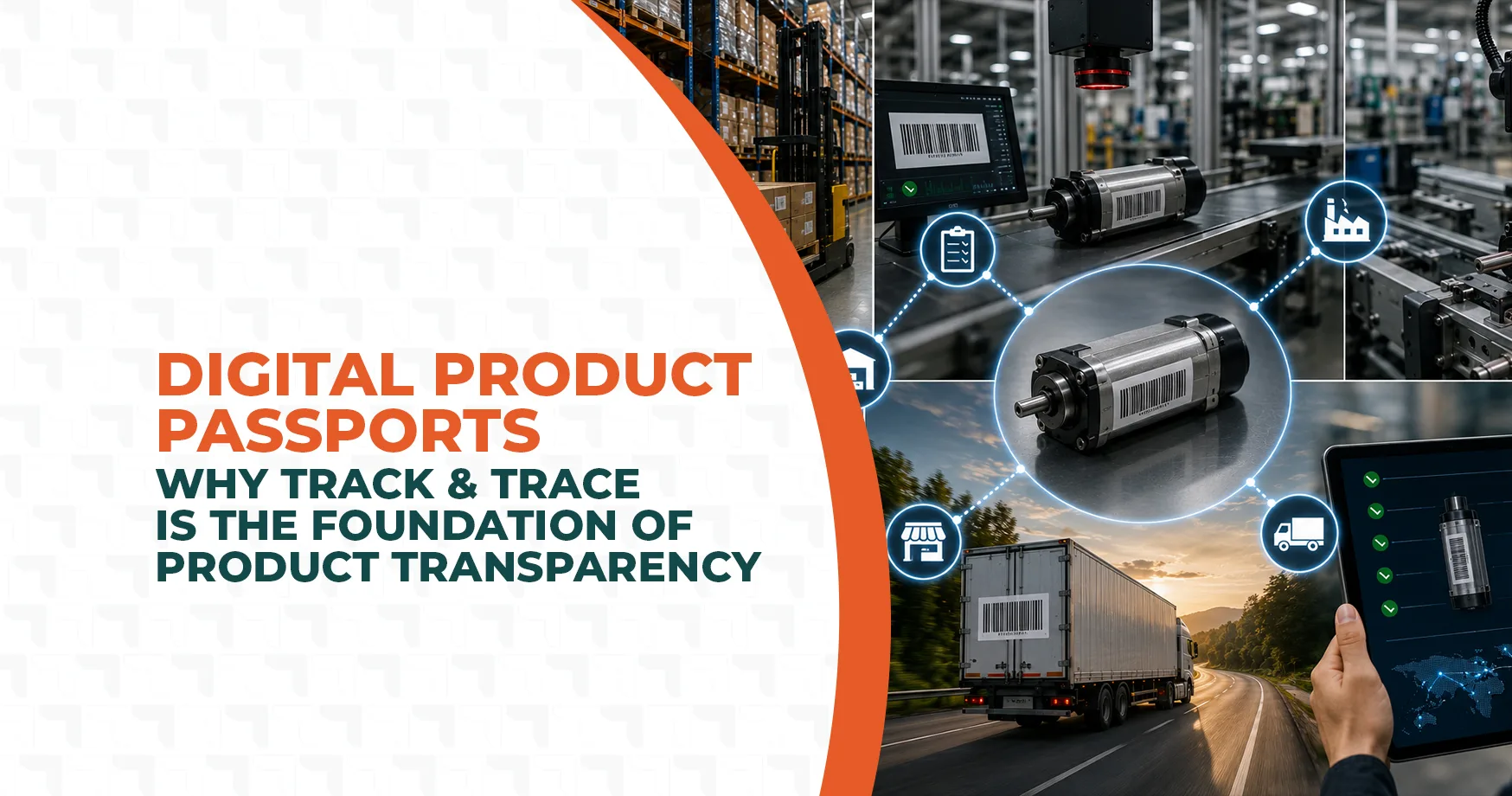
Put simply, track-and-trace is the operational engine of the Digital Product Passport. A DPP depends entirely on reliable data flowing from the physical product into digital form. BCI describes how track & trace systems deliver “full lifecycle visibility” by digitally tagging everything from raw materials to shipped products. In practice, the flow looks like this:
- Unique Identification: At the first station, each product or batch is assigned a serialized ID. This can be a printed barcode, an RFID label, or a laser-etched code. This identifier sticks to the item through all subsequent processes.
- Data Capture: As items move through production and warehousing, all movements and activities are scanned or recorded. In a modern system, handheld scanners, fixed cameras or RFID portals automatically log each event: raw material receipt, assembly completion, quality check, packing, loading, etc. Each scan ties the product ID to a timestamp and location in the database.
- Real-Time Validation: Automated vision systems and barcode/OCR readers verify that the correct product is being processed, and that labels are readable. For example, high-resolution cameras will check that a printed barcode matches the expected sequence and that the product is oriented correctly. This step ensures data integrity – bad scans or mis-IDs are caught immediately (for instance, an Indian automotive plant achieved 100% traceability and zero inspection errors by using vision systems at critical checkpoints).
- Integrated Enterprise Systems: All captured events feed into ERP, WMS, MES or a supply-chain control tower. This means operators see the live status of each serialized product in their existing systems, and downstream systems (like SAP or inventory databases) are automatically updated. The result is that nothing falls through the cracks – a dispatch manager can instantly query the history of a carton by its DPP ID.
Each of these layers is foundational. Without serialized labeling and scanning (Step 1-2), there is no data to put into the DPP. Without validation (Step 3), errors would corrupt the passport. Without system integration (Step 4), captured data would remain in silos. In short, DPPs inherit all the benefits of a strong track-and-trace program: real-time visibility, rapid fault detection, and a digital chain of custody for every item.
BCI’s Track & Trace solutions embody these principles. They assign and print unique IDs for every SKU level, support automated scanning at every process step, and provide vision-based inspection to catch errors on the fly. By the time a product is ready to ship, its BCI-powered passport data is complete, accurate and synchronized across ERP/WMS/MES.
Bar Code India’s Track & Trace Solutions
Bar Code India offers a comprehensive track-and-trace platform designed to deliver exactly the capabilities DPPs need. Key features include:
- Multi-level Serialization: BCI’s system ensures precise identification of SKUs at the batch, component, case, pallet and shipment levels. Every item is labeled with a unique serial number (barcode or RFID), and BCI supports building up aggregation hierarchies (linking inner pack codes to case codes, and so on) so that every unit’s genealogy is known.
- Integrated Hardware Portfolio: BCI provides the physical tools to make data capture happen. This includes high-speed thermal printers and print-and-apply applicators (for labeling on the line), handheld and fixed industrial scanners, RFID readers, and even laser marking systems for direct part marking. For verification, BCI offers machine-vision inspection cameras and smart sensors to ensure codes are printed and read correctly. In short, BCI has “devices that generate your data” covered – from sensors and vision cameras to data-capture terminals.
- Real-Time Event Logging: BCI’s software captures every scanned transaction and IoT sensor event in real time. Barcode scans on the production floor, RFID reads in the warehouse, weight measurements – all feed directly into the Track & Trace database. This creates a continuous chain of custody for the DPP. According to BCI, their solution “ensures seamless e-warranty management… while fostering long-term consumer loyalty through verified product authenticity”. The same traceability that supports warranties will populate the DPP’s usage and service history fields.
- Validation & Compliance: The platform includes rules and workflows to validate each step against the expected process. For example, if a product is supposed to go through a test station or require a specific certificate, the system will flag or prevent completion if it’s missing. This level of control is essential for DPP accuracy: non-conforming items simply cannot be logged into the passport data. BCI’s vision inspection ensures that labels match the system records before a product progresses, minimizing garbage-in, garbage-out risk.
- ERP/WMS/MES Integration: Importantly, BCI solutions integrate with enterprise systems. Track & Trace can feed data into the plant MES or an ERP directly via API or middleware. BCI also offers WMS and manufacturing execution systems that natively communicate with its track & trace module. This ensures that serialized tracking data automatically syncs with order and inventory data. In practice, every scan updates both the DPP database and the company’s master records, ensuring consistency. As BCI notes, connecting to ERP/PLM platforms “ensures production data is instantly available across departments”.
- Data Governance and Visibility: Beyond the platform, BCI provides analytics and control towers for the captured data. Executives can monitor product flows, recall status, and compliance KPIs in dashboards. This helps meet the “open data” spirit of the DPP mandate – summarized product information can be shared or published as needed. All data exchanges are logged and auditable, satisfying regulators’ requirements for traceable records.
In short, Bar Code India’s track and trace solutions cover all aspects of the DPP value chain: from encoding identity onto products, to capturing and verifying every step, to integrating with IT systems and surfacing actionable data. For brands operating in India (or globally), BCI acts as the enabler that transforms the theoretical DPP into a practical reality.
DPP Data Requirements vs. BCI Track & Trace Capabilities
DPP Data/Requirement
BCI Track & Trace Capability
Unique product ID & serialization: Each item/batch needs a standardized barcode/RFID (ISO 15459).
BCI provides serialization at every SKU level (batch, component, pack, pallet) with GS1-compliant barcodes/RFID tags.
Multi-level aggregation: Tracking case/pallet relationships up the packaging hierarchy.
BCI’s system supports aggregation rules, linking inner packs to cases and cases to pallets so that the chain of custody is preserved.
Event capture (real-time logs): Timestamped logs of production, packaging and movement events.
BCI uses handheld/fixed scanners, RFID portals and sensors to capture every scan or transaction in real time. Data is recorded continuously into the enterprise system.
Code & label verification: Ensuring codes are printed and read correctly to prevent data errors.
BCI offers machine-vision inspection cameras and software that automatically validate printed codes, catching errors before they enter the system.
Systems integration: Feeding trace data into ERP/WMS/MES and retrieving master data.
BCI Track & Trace integrates with ERP, WMS and MES via APIs or middleware, ensuring captured data updates master records and is available to all stakeholders.
Consumer engagement (e.g. warranty, recall): Post-sale tracking and product authentication.
BCI’s solution enables e-warranty management and automated recall workflows tied to serial numbers, building consumer trust and enabling after-sales traceability.
As the industry prepares for product passports, the time to act is now. Bar Code India (BCI) offers proven Track & Trace solutions to make this transition seamless. Our end-to-end platform ensures every product is uniquely identified, automatically scanned, and verified through production – exactly what the new DPP mandates demand. Partnering with BCI means gaining both the technology and expertise to meet regulatory requirements and build supply chain excellence. Contact BCI today to see how we can help your organization capture, manage, and leverage product data for compliance, efficiency, and competitive advantage.