

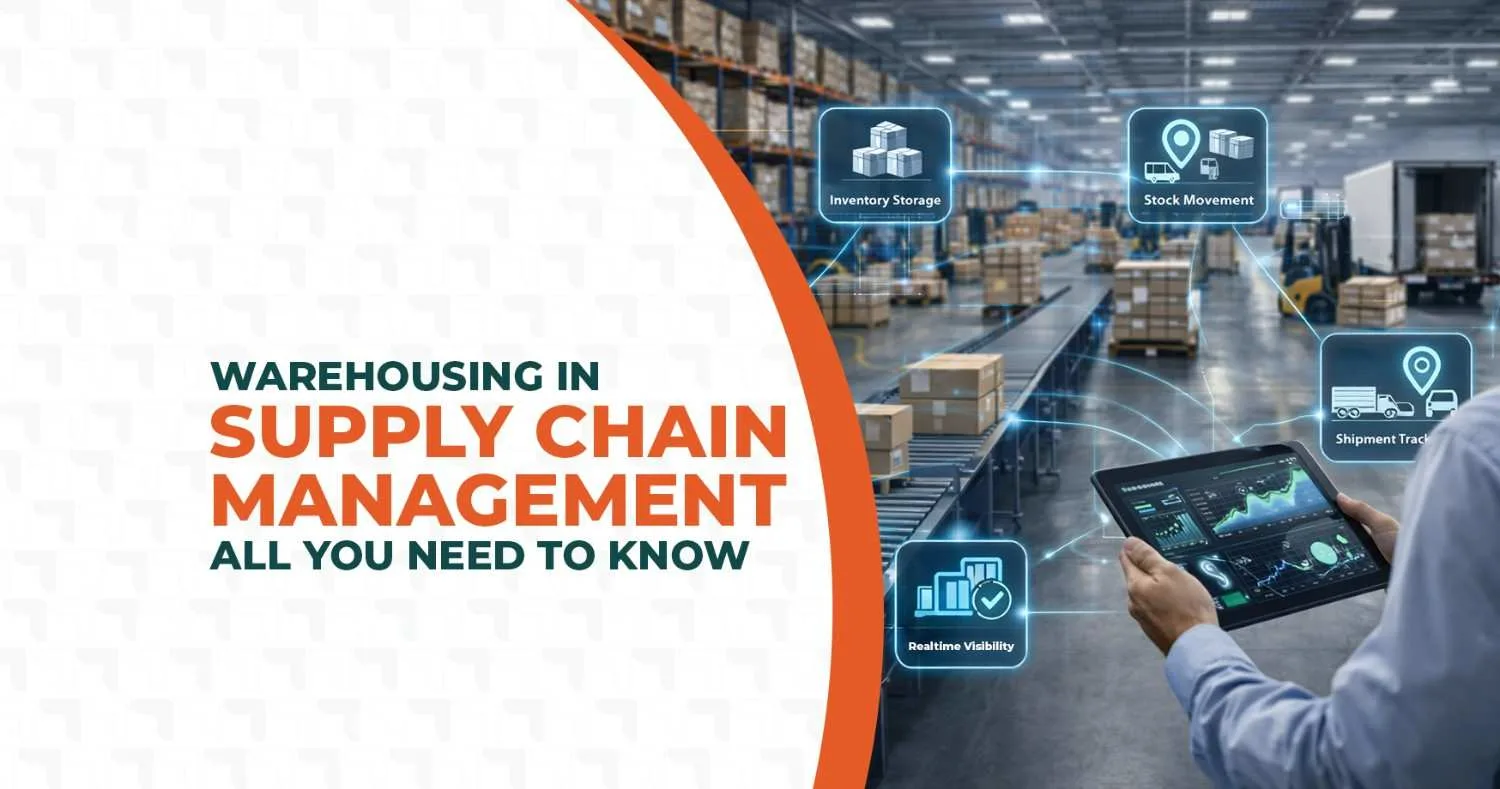
Warehousing in Supply Chain Management- All You need to Know
The growth of the global warehousing market is fueled by rapid e-commerce expansion and unpredictable supply chain disruptions. Warehousing no longer represents a passive storage site. It functions as a strategic control point that supports inventory balance, stable product flow and overall supply chain performance.
Warehousing in the supply chain refers to the structured storage, movement and management of goods. It ensures the right product is available at the right time and in the right condition.
Read this blog to explore the core functions of warehousing, its strategic importance, the modern technology stack that supports operations, industry challenges and future trends.
What Are The Core Functions of Warehousing in Supply Chain
Warehousing sits at the center of supply chain movement. Every operation inside a warehouse influences fill rate, accuracy, delivery speed and working capital. Below is a breakdown of the main operational functions.
1. Inbound Operations
Inbound operations decide how smoothly inventory enters the system. Errors at this stage lead to misplaced stock, delayed orders and planning failures later.
Receiving steps include the following
- Quality checks
- Quantity verification
- Scanning and labeling
- Matching against purchase orders
- Updating the WMS
When teams use barcode scanners or RFID readers connected to the WMS, verification becomes almost instant. This ensures cleaner data from the very first touchpoint.
Putaway relies on structured slotting. Fast moving items sit in accessible areas. Slow movers go deeper inside storage. Operators travel less distance, which improves productivity and reduces congestion.
2. Inventory Control
Inventory control keeps the warehouse running with accuracy and predictability. It involves continuous monitoring of what exists inside storage and where it is located.
Key processes include perpetual inventory tracking, cycle counts and stock rotation. Demand forecasting models reduce the risk of stockouts. With a reliable WMS and automated tracking technologies, warehouses can control this risk and maintain stability.
A warehouse loses efficiency whenever stock is not where the system claims it should be. Accurate data flows and regular system updates create reliable visibility across the entire supply chain.
3. Outbound Operations
Outbound operations shape the customer experience. These tasks involve selecting the right product, preparing it in the correct format and dispatching it on time.
Picking is one of the most labor intensive activities. Different strategies suit different environments. Batch picking works well for high volume orders with shared SKUs. Zone picking reduces walking time when operators focus on specific areas. Wave picking aligns work with shipping schedules.
Packing and shipping then prepare products with correct documentation and compliance checks. Cross docking bypasses storage and moves goods directly from receiving to dispatch. This can reduce order cycle time.
4. Value Added Services
Warehouses today support more than storage and movement. They play an important role in preparing products for final customers. Common services include kitting, relabeling, bundling, promotional packaging and light assembly.
Reverse logistics is another growing segment. E-commerce returns rise nearly fifteen percent year on year. A warehouse that can inspect, recondition and return products to stock quickly helps brands maintain customer satisfaction while reducing losses.
Strategic Role of Warehousing in Modern Supply Chains
Warehousing has become a foundational pillar in supply chains. It absorbs volatility and protects business continuity during disruptions.
1. Warehouses as Stability Centers
During major events such as port closures or transport delays, warehouses act as buffers. They support inventory reserves and smoothen fluctuations in demand.
2. Support for Omnichannel Distribution
The rise of e-commerce has created complex order patterns. Warehouses now manage distribution for online and offline channels together. Micro fulfillment centers inside cities enable fast delivery. Dark stores support dense order picking. Zone based allocation helps maintain stock availability for all platforms.
3. Location Strategy
A warehouse placed near highways or multimodal transport points shortens lead times and improves customer experiences. However, geographic placement alone does not determine warehouse performance. How space is allocated and managed inside the facility is equally critical. With the support of WMS solutions, warehouses can practice intelligent space allocation structured slotting logic that assigns storage locations based on SKU velocity, product dimensions and order frequency.
4. Digital Synchronization Across the Supply Chain
Warehouses now sit inside a larger digital network. Integration with ERP, CRM, and planning systems allow real time decisions. WMS platforms like the one offered by Bar Code India (BCI) synchronize order data, inventory movements and compliance events across departments. This creates stable visibility from procurement to delivery.
Evolution of Warehouse Technology Stack and How Bar Code India Strengthens It
Technology inside warehouses has matured from manual registers to intelligent and automated systems. Yet technology matters only when it directly improves workflow efficiency and supply chain performance.
Bar Code India’s technology stands out because it fits into every stage of the warehouse lifecycle. It does not function as an isolated solution. It works as an integrated ecosystem that improves productivity, accuracy and visibility.
Identification Technologies such as Barcodes/RFID and Scanners
Every warehouse workflow begins with identification. The system must know what item has arrived, what quantity is present and where it should go next. Barcodes/RFID and scanners form the base of this activity.
When integrated with the WMS, they enable up to 99% inventory visibility, allowing warehouses to track stock accurately and maintain better control over operations. They also increase operator speed because scanning is almost instant.
How BCI supports the workflow
Bar Code India manages warehouse operations through its WMS, which standardizes workflows, enforces operational rules, and handles exceptions across all stages. It ensures tasks follow defined logic, reducing dependency on individual operators and minimizing process gaps. Mobile computers, scanners, printers support this system by capturing execution data at each step. This alignment allows warehouses to reduce process deviation, improves auditability, and keeps operations consistent even at scale.
RFID Tracking Technology and BCI Dristi Readers
RFID improves warehouse visibility without line of sight scanning. It allows teams to capture hundreds of items in a single read. This is useful when operations involve pallets, cases or conveyor movement.
Traditional RFID readers struggle with interference or slow performance. BCI Dristi readers solve this problem by using strong Impinj chipsets and edge processing. This results in faster reading, better sensitivity and smoother integration.
How Dristi fits into the warehouse workflow
BCI Dristi seamlessly integrates with the Warehouse Management System to automate key warehouse touchpoints. From instant pallet reads at receiving portals to high-speed outbound validation at docks, Dristi ensures real-time visibility, automated cycle counts, and error-free material movement across storage zones, conveyors, and dispatch areas
.
IoT and Sensor Technology with Senskon
Warehouses do not only track products. They monitor conditions around products. Temperature, humidity, vibration and pressure influence stock quality. IoT devices help warehouse managers maintain compliance and respond quickly to deviations.
BCI Senskon devices collect multi parameter data and send it securely to cloud systems. They work with Wi Fi, cellular networks and common industrial interfaces.
How Senskon supports warehouse workflows
Cold storage sections remain within safe ranges
- Machinery such as conveyors and sorting systems can be monitored for vibration patterns
- Energy usage can be optimized in large facilities
- Abnormal events trigger alerts for faster action
This builds operational stability and improves the safety of stored materials.
Warehouse Software Layer with BCI WMS
BCI’s Warehouse Management System (WMS) acts as the operational software layer that manages all inbound, outbound, and inventory workflows. It intelligently directs operators, allocates tasks, and records performance metrics for full warehouse control and accountability.
The system supports barcode and RFID-based workflows, integrates smoothly with automation systems such as AMRs, machine vision, and pick-to-light systems, and connects seamlessly with ERP and control platforms for unified data synchronization. Its device-agnostic interface works across web, mobile, and Android environments, ensuring accessibility and ease of use.
BCI WMS delivers real-time visibility across receiving, storage, and dispatch zones while enabling accurate order fulfillment and data-driven warehouse optimization. It is adaptable to industry-specific workflows, supporting batch control and compliance in pharmaceuticals, kitting and bundling in automotive operations, and FEFO/FIFO shelf-life tracking for FMCG industries.
Automation and AI Layer with Control Tower Intelligence
Automation increases throughput and reduces dependency on labor. AMRs and ASRS systems improve movement. AI engines analyze past patterns and guide future decisions.
This is where warehousing becomes connected with the larger supply chain. Decision makers gain complete visibility of product flow across plants, warehouses, distribution centers and logistics networks.
Challenges and Proven Solutions For Warehousing in Supply Chain
Warehousing challenges affect cost, speed, accuracy and the overall health of the supply chain. The good news is that businesses now have clear pathways to overcome these issues by adopting structured processes and the right technology stack.
- Poor Inventory Visibility and Accuracy
- Labor Inefficiency and Human Errors
- Lack of Process Standardization Across Locations
- Slow Order Fulfillment and Inefficient Space Utilization
- Limited Integration Between Systems
What Businesses Can Do Next
Warehousing now plays a strategic role in supply chain performance. Every workflow inside it, from receiving to dispatch, shapes delivery speed, cost control and customer confidence.
Businesses face rising labour shortages, accuracy issues and space pressure, which makes manual operations harder to sustain. Modern technology helps close these gaps by giving warehouses real time visibility, process consistency and stronger data accuracy.
Barcoding, RFID, automation and an integrated WMS create a connected environment that supports faster decisions and stable fulfilment. Organisations can begin with small pilots, refine processes and scale gradually. To explore how your warehouse can move toward a smarter operating model, connect with BCI for a custom readiness assessment.