
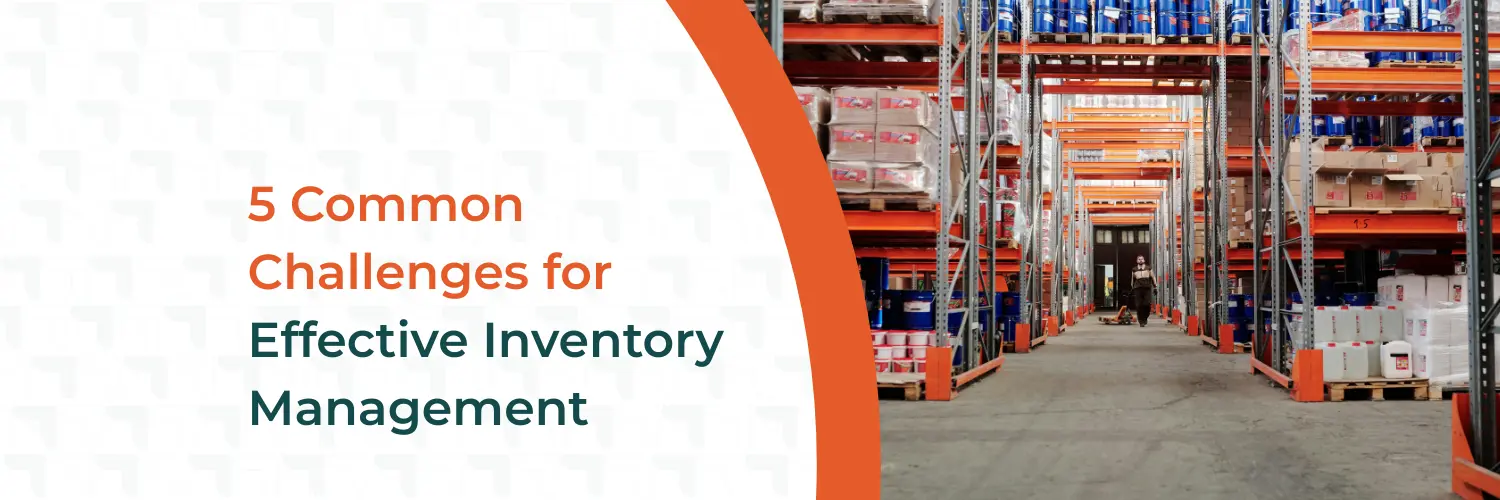
5 Common Challenges for Effective Inventory Management
Effective Inventory Management helps in significantly reducing costs and is crucial for a company to comprehend its inventory to attain both effective and rapid operations while minimizing disruptions. Businesses and their revenues are often impacted by ineffective management of their inventory. Across the globe, retailers alone have recorded losses of a hefty $1.75 trillion due to mismanaged inventory. Enterprises must have a dependable solution in place to streamline the Inventory Management processes. Here are five of today's most common and complex challenges being faced by organizations for effective inventory management, along with their solutions:
1. Lack of Inventory Visibility
The bottom line of an organization suffers from insufficient, hard-to-locate, or inaccurate inventory. Organizations in general do not devote sufficient time to comprehending the facility's architecture and establishing how to maximize space usage while facilitating worker access to items. The lack of inventory visibility often results in excess ordering and delayed distribution, which translates to revenue loss for such organizations. Planned storage is essential for facilitating efficient inventory management in your firm.
Solution: Real-time inventory management system
A real-time inventory management software empowers you with accurate information on the stock availability and its associated storage location inside the four walls. Having an accurate count and location of inventory significantly improves the order fulfilment process, helping retain customer loyalty.
2. Incorrect Data Entry
Incorrect data entry is one of the most common errors observed during inventory audits. With manual data entry, an employee could accidentally push the wrong button or misspell information, resulting in inaccurate data. Process adherence and data integrity are entirely dependent on human/manual activities; therefore, there is always a degree of risk involved.
Solution: Capture data at the point of activity or operation
An efficient inventory management system reduces inaccuracies by using the right technology to directly capture data at the point of activity. The automated system prevents human errors in data entries while also increasing the overall speed and efficiency of the operations.
3. Aged Inventory and Dead Stock
There could be several reasons why some inventory could be sitting on the warehouse shelves for a prolonged time. Aged inventory or dead stock can severely impact an organization’s cash flow as organizations are forced to sell the aged goods at a lower price while also incurring additional maintenance and storage costs for the duration that they’ve been on the shelves.
Solution: A system to ensure FIFO/FEFO/FMFO-based picking process
An efficient inventory management system offers a range of picking procedures, such as First-In, First-Out (FIFO), FMFO, and First-Expired, First-Out (FEFO) to help you actively manage your inventory rotation and avoid aged inventory and dead stock occurrences. A real-time dashboard that shows you the shelf life of your goods, especially perishable inventory, can help sell the aged inventory before it becomes dead stock and prevent incurring a complete loss for an organization.
4. Excess or Over-Replenishment
Purchasing resources without first selling the ones you already have can severely impact the cash flow of an organization. When done manually, existing inventory or resources are often overlooked or not accounted for, resulting in excess procurement of the same stock-keeping unit.
Solution: System to ensure accurate inventory and maintain configured inventory levels
An efficient inventory management system provides real-time visibility of the inventory levels of all the goods in a warehouse to avoid excessive or over-replenishment scenarios. Inventory levels can also be configured in such a system to send alerts to the process owners for active replenishment.
Recommended: What is warehouse management system
Organizations without an effective inventory management system would vouch for Inventory reconciliation being one of the most cumbersome and time-consuming processes that they have to deal with. Even after spending many hours or, in some cases, days to complete the manual inventory reconciliation process, organizations often encounter stock reconciliation discrepancies and are usually at a loss to understand the reason behind such occurrences. Carrying out manual inventory reconciliation often also results in incurring additional associated labour costs.
Solution: Tech-driven and paperless Inventory reconciliation system
An efficient inventory management solution facilitates organizations to have a Digital and Tech-enabled approach to their inventory reconciliation process. This reduces the scope for errors and discrepancies during inventory reconciliation, while also significantly speeding up the overall time taken to complete the process.
Conclusion
The inventory management system of an organization is key to its overall operational efficiency and profitability. Firms must select a high-quality inventory management system to reduce costs, increase productivity, sales, and profit, and improve the overall efficiency of their supply chain. You can learn more about the challenges you might have, and the solution offered here. We’re always happy to help.
You may also find these topics Interesting
Share this page

India Has Built a Defence Manufacturing Industry. Now It Has to Prove What It Builds

What Is Pharmaceutical Serialization? Definition, Requirements & How It Works
Types of Inventory Control: Systems, Methods, and Technologies for Better Warehouse Visibility