
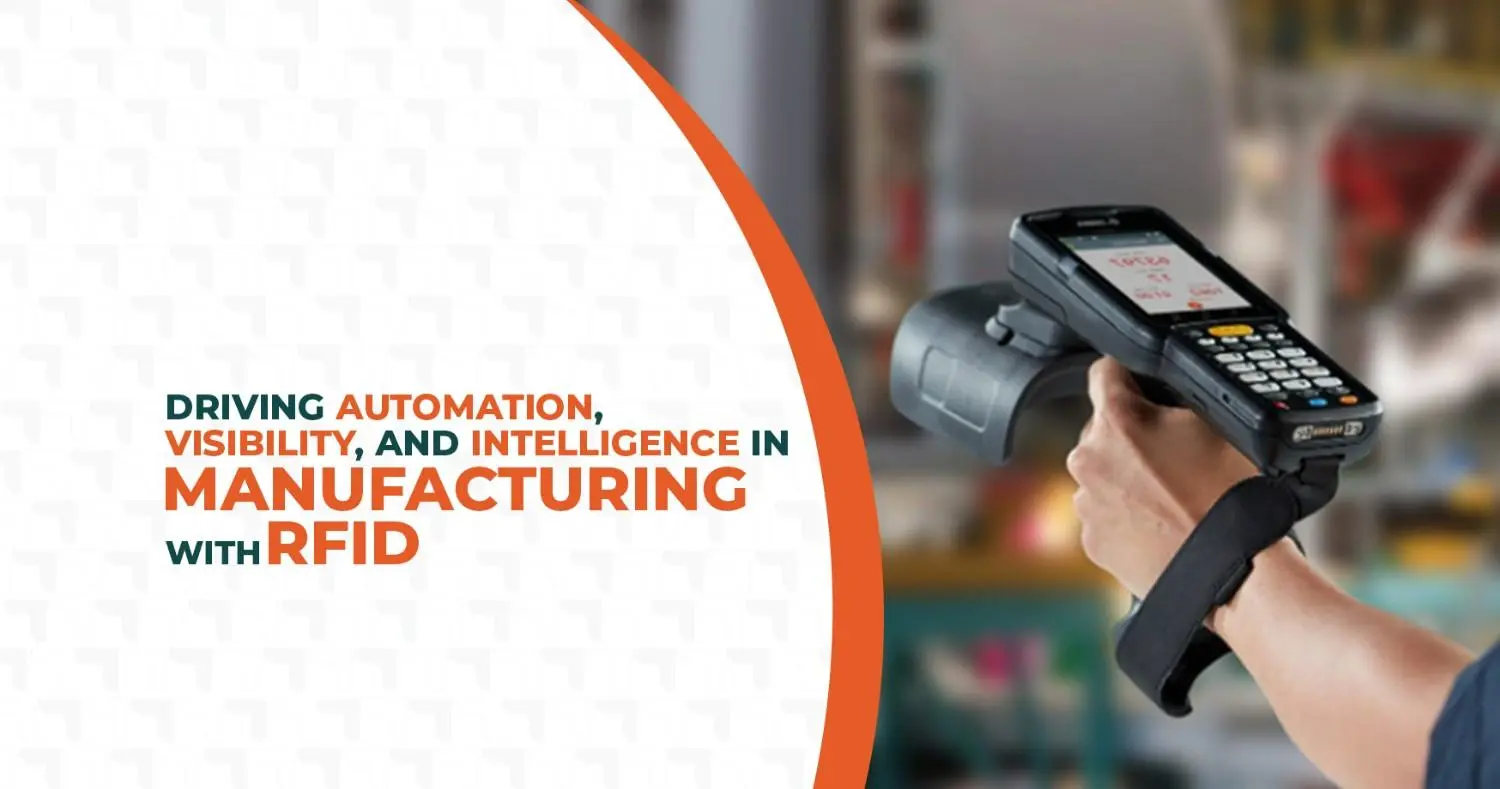
Driving Automation, Visibility, and Intelligence in Manufacturing with RFID
As manufacturing industries race toward digital transformation, understanding how RFID in manufacturing works has become pivotal for decision-makers who aim to optimize resources, enhance visibility, and integrate factory operations into a data-driven ecosystem. Radio Frequency Identification (RFID) operates at the heart of this transformation, bridging physical production processes with digital intelligence to enable truly connected, automated factories.
Role of RFID in Manufacturing?
At its core, RFID in manufacturing automatically identify and track tags attached to physical objects; ranging from raw materials and tools to finished products and logistics containers.
RFID does not require direct line-of-sight scanning. It can capture data from multiple assets simultaneously, yielding unmatched speed and accuracy.
This real-time data flow ensures manufacturers gain a unified view of material movements, production activities, and stock levels—forming the foundation of smart manufacturing operations.
Understanding How RFID in Manufacturing Works
To comprehend how RFID in manufacturing works, one must look at how each system component contributes to real-time traceability:
- Tagging: These RFID-based tags are affixed to parts, tools, or products. Each tag carries a unique code linked to relevant production or inventory information.
- Scanning: Installed across manufacturing zones such as entry gates, assembly lines, and warehousing areas, readers capture tag data wirelessly, even without direct visual contact.
- Data Capturing: This layer cleans, aggregates, and channels the captured data into enterprise systems like MES and WMS, providing end-to-end visibility.
For manufacturers, understanding how RFID in manufacturing works is not merely about the technology stack but is about how this ecosystem integrates with broader automation workflows, enabling synchronized, error-free operations across complex production lines.
The Benefits of RFID in Manufacturing
Companies embracing this technology unlock measurable transformations. The key benefits of RFID in manufacturing include:
- Enhanced visibility: Real-time updates on material movement and inventory status ensure transparency across departments.
- Process automation: Contactless data capture reduces manual scanning, delays, and input errors, streamlining production.
- Accurate track and traceability: Each product’s history—from raw material to shipment—is automatically documented.
- Regulatory compliance: RFID-enabled product serialization and material tracking support adherence to industry regulations.
- Operational efficiency: Synchronized data across MES, WMS, and ERP reduces downtime, waste, and stock imbalances.
These benefits illustrate that RFID is more than an identification technology; it is the backbone of digital manufacturing intelligence.
RFID Components and the Role of Dristi
Modern manufacturing increasingly relies on RFID technology to automate identification, tracking, and visibility across production and supply chain processes. A complete RFID setup integrates several key components:
- RFID Readers: Core devices that capture tag data at critical checkpoints such as receiving, assembly, and dispatch. Fixed readers Like Dristi automate read events, eliminating manual scans.
- RFID Antennas: Enable wireless communication between tags and readers, forming defined read zones for automated tracking.
- RFID Tags and Labels: Carry unique identifiers for products, components, or pallets, supporting serialization and full traceability.
- RFID Printers and Print & Apply Systems: Encode and apply RFID labels in real time during packaging or material movement.
At the heart of this ecosystem is BCI’s Dristi series—industrial-grade fixed RFID readers designed for rugged manufacturing environments.
RFID Applications in the Manufacturing Industry
RFID is redefining diverse manufacturing domains by combining automation, precision, and connectivity.
a. Semiconductor Manufacturing
- Tracks wafers, tools, and carriers in real time to streamline cleanroom operations.
- Enables predictive insights when integrated with AI to optimize line utilization and yield.
b. Pharmaceutical and Healthcare
- Facilitates batch-level serialization for compliance.
- Reduces human error during labeling and packaging by combining Dristi’s visual analytics with RFID tracking.
c. Automotive and Electronics
- Enhances supplier collaboration through end-to-end track and traceability of parts and assemblies.
- Uses RFID‑enabled tracking systems to automate inventory replenishment and assembly scheduling.
e. Renewable and Solar Manufacturing
- Monitors solar components and panels across production and field installations.
- Supports sustainability reporting by tracking materials and ensuring resource traceability.
Quantifying the Benefits: ROI and Performance Impact
The benefits of RFID in manufacturing are underscored by tangible performance outcomes:
- Reduction in manual effort and scanning time.
- Increased inventory accuracy and material accountability.
- Shorter lead and cycle times across production and logistics.
- Enhanced compliance and audit readiness through automated traceability trails.
For decision-makers, this equates to faster ROI, data consistency across functional layers, and scalability to meet dynamic market demands.
Conclusion: Building the Future of Manufacturing with RFID
Understanding how RFID in manufacturing works reveals its transformative potential: from tracking items to building interconnected, intelligent production ecosystems. It ensures measurable gains in visibility, compliance, and speed—strengthening competitiveness in highly automated industries.
Through its advanced technology such as Dristi, and deep integration expertise across MES and WMS systems, Bar Code India (BCI) empowers manufacturers to leverage the full scope of RFID applications in manufacturing industry. With proven expertise in automation, data integration, and track and traceability, BCI continues to enable enterprises to design smarter, more agile, and fully digitized operations.